Creating high-quality content is essential for improving SEO, increasing organic traffic, and achieving better Google rankings. One important part of content optimization is understanding how often your target keyword appears in an article. This is where Keyword Density Analysis becomes useful. It helps you maintain a natural balance between keyword usage and readability, making your content more valuable for both users and search engines. However, modern SEO is no longer about repeating keywords multiple times.
Search engines now focus on search intent, content quality, user experience, and semantic keywords to determine rankings. By combining effective keyword research, on-page SEO, and well-structured content, you can improve search visibility and attract more website visitors. This guide explains how Keyword Density Analysis works, why it matters, and the best practices to optimize your content for long-term SEO success.
What Is Keyword Density Analysis?
Keyword Density Analysis is the process of measuring how many times a target keyword appears in relation to the total number of words on a webpage. It helps content creators maintain a natural keyword frequency while ensuring the content remains informative and easy to read.
The basic purpose of keyword density is to check whether a keyword is underused or overused. Although Google no longer relies on keyword density as a primary ranking factor, it still helps writers create content with proper keyword placement and topical relevance.
For example, if your article contains 2,000 words and your target keyword appears 20 times, the keyword density is 1%.
Maintaining a balanced keyword frequency allows search engines to understand the page topic without making the content appear spammy.
Why Does It Matter?
A well-balanced keyword strategy helps:
- Improve content relevance
- Support better search engine optimization
- Increase organic search visibility
- Enhance user experience
- Keep content natural and readable
- Prevent keyword stuffing
- Strengthen topical authority
Instead of focusing only on repeating one keyword, modern SEO encourages the use of semantic keywords, related search terms, and topic clusters.
How to Calculate Keyword Density?
Keyword Density Analysis uses a simple mathematical formula.
Formula
Keyword Density (%) = (Number of Keyword Mentions ÷ Total Word Count) × 100
Example 1
Total words: 1,000
Keyword appearances: 10
Density:
(10 ÷ 1,000) × 100 = 1%
Example 2
Total words: 2,500
Keyword appearances: 15
Density:
(15 ÷ 2,500) × 100 = 0.6%
Both examples show a natural keyword frequency suitable for long-form SEO content.
Ideal Keyword Density for Better Rankings
There is no official keyword density percentage recommended by Google.
However, SEO experts generally suggest keeping keyword usage between 0.5% and 1.5%, depending on the article length and writing style.
Instead of aiming for a specific percentage, focus on natural keyword placement.
A good SEO article usually includes the primary keyword in:
- Page title
- URL
- First paragraph
- One or two headings
- Body paragraphs
- Conclusion
- Meta title
- Meta description
This approach helps search engines understand the content without affecting readability.
Remember that content quality is always more important than keyword frequency.
How Search Engines Understand Keywords Today?
Modern search engines use artificial intelligence and natural language processing to understand content. Instead of looking only for exact-match keywords, Google analyzes:
1. Search Intent
Search intent is one of the most important ranking signals used by search engines today. Every search query has a purpose, and Google's goal is to understand that purpose before displaying results. Instead of focusing only on the words typed into the search bar, search engines analyze what users are actually trying to accomplish. Someone searching for "best SEO tools" is likely looking for product comparisons, while someone searching for "what is SEO" expects educational content. If your content matches the user's intent, it has a much better chance of ranking higher.
Creating content around search intent also improves user satisfaction. When visitors quickly find the information they need, they are more likely to stay on the page longer, explore additional content, and return in the future. These positive engagement signals further strengthen your website's SEO performance.
Types of Search Intent
Search Intent | User Goal | Example Search Query | Best Content Format |
Informational | Learn something | How does SEO work? | Blog post, guide, tutorial |
Navigational | Visit a specific website | Google Search Console | Homepage or landing page |
Commercial Investigation | Compare options | Best keyword research tools | Comparison article, review |
Transactional | Complete a purchase or action | Buy SEO software | Product page or pricing page |
Why Search Intent Matters
- Helps create content that answers user questions accurately.
- Improves engagement by matching visitor expectations.
- Reduces bounce rates because users find relevant information.
- Increases the likelihood of ranking for competitive keywords.
- Supports better conversion rates by delivering the right content at the right stage of the buying journey.
2. Semantic Keywords
Modern search engines understand that a topic cannot be explained using only one keyword. Instead, they look for semantic keywords, which are words and phrases closely related to the primary topic. These related terms help search engines understand the context of your content and determine whether it provides comprehensive coverage.
For example, an article about SEO naturally includes terms such as "organic traffic," "keyword research," "content optimization," and "Google ranking." These words reinforce the main topic without requiring constant repetition of the same keyword. Semantic keywords also make your writing more natural and easier to read.
Including related keywords throughout your content helps you rank for multiple search queries while improving topical relevance. It also demonstrates that your article thoroughly covers the subject instead of focusing on a single phrase.
Examples of Semantic Keywords
Primary Topic | Related Semantic Keywords |
SEO | Search engine optimization, website ranking, search visibility |
Content Marketing | Blog writing, digital marketing, audience engagement |
Keyword Research | Search volume, keyword difficulty, long-tail keywords |
On-Page SEO | Meta title, heading tags, internal links, URL structure |
Organic Traffic | Search rankings, website visitors, Google Search |
Benefits of Semantic Keywords
- Makes content sound more natural and conversational.
- Helps search engines understand the overall topic.
- Improves the chances of ranking for related search terms.
- Supports comprehensive content optimization.
- Reduces the need to overuse a single keyword.
3. Natural Language Processing (NLP)
Natural Language Processing (NLP) is an AI technology that enables search engines to understand human language more effectively. Rather than scanning a webpage for exact keyword matches, NLP evaluates how words relate to each other within sentences and paragraphs. It identifies the meaning behind phrases, recognizes synonyms, and interprets context much like a human reader.
For example, if an article mentions "Google ranking," "organic search," "search visibility," and "content optimization," search engines understand that the page is discussing SEO, even if the exact keyword is not repeated frequently.
NLP has also improved Google's ability to understand conversational searches, voice search queries, and complex questions. This is why writing naturally is now much more effective than forcing keywords into every sentence.
How NLP Helps Search Engines
NLP Feature | Purpose | SEO Benefit |
Context Recognition | Understands surrounding words | Improves relevance |
Entity Recognition | Identifies people, places, brands, and products | Better topic understanding |
Synonym Detection | Recognizes similar words | Supports natural writing |
Phrase Analysis | Understands relationships between words | Improves search accuracy |
Sentence Structure Analysis | Evaluates readability and clarity | Rewards well-written content |
Why NLP Is Important
- Understands the meaning behind user queries.
- Rewards content written for humans instead of search engines.
- Improves the quality of search results.
- Encourages comprehensive topic coverage.
- Supports voice search and conversational search optimization.
4. Topic Authority
Search engines evaluate not only individual pages but also the overall expertise of a website. A website that consistently publishes high-quality content about a specific subject is more likely to be viewed as an authoritative source.
For example, if your website includes detailed articles about keyword research, technical SEO, on-page SEO, link building, content marketing, and SEO audits, search engines recognize that your site covers the topic comprehensively. This strengthens your topical authority and increases your chances of ranking for competitive keywords.
Building topic authority requires publishing interconnected content, updating existing articles, and using internal links to connect related pages.
5. Content Quality
Content quality remains one of the strongest ranking factors in modern SEO. Search engines aim to provide users with accurate, reliable, and useful information. Articles that answer questions thoroughly, include credible information, and are easy to read are more likely to perform well in search results.
High-quality content should be well-structured, regularly updated, and written in clear language. It should also include examples, visuals, tables, and practical advice where appropriate. Rather than writing solely for algorithms, focus on creating content that genuinely helps readers solve their problems. A strong internal linking strategy helps connect related pages, improve website navigation, and distribute SEO value across your website.
Elements of High-Quality Content
Quality Element | Importance |
Original Content | Offers unique insights and value. |
Accurate Information | Builds credibility and trust. |
Clear Organization | Improves readability and navigation. |
Updated Information | Keeps content relevant. |
Practical Examples | Helps readers understand concepts more easily. |
Best Practices
- Write comprehensive answers.
- Use short paragraphs and descriptive headings.
- Support claims with reliable information.
- Update articles regularly.
- Focus on solving user problems instead of simply ranking for keywords.
1. CrawlHunt
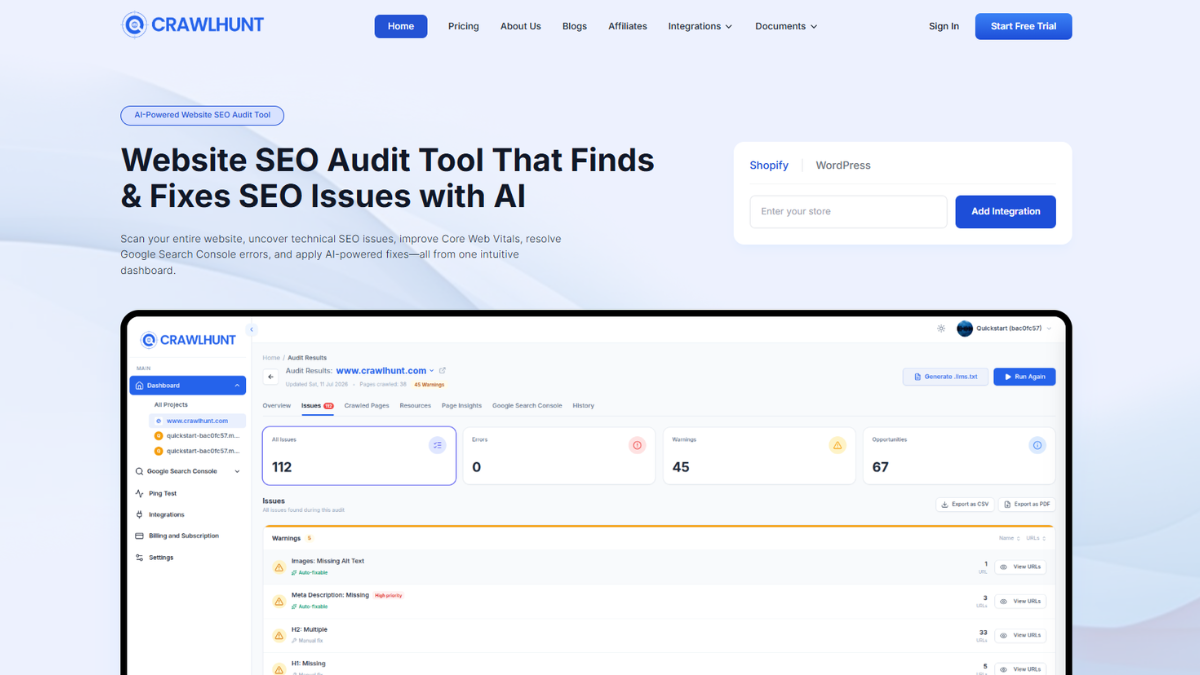
CrawlHunt is an AI-powered technical SEO platform designed to help website owners identify, manage, and fix SEO issues that affect search engine rankings. While it does not currently offer a dedicated Keyword Density Analysis feature, it provides a complete website audit system that improves overall SEO health. CrawlHunt focuses on technical SEO, on-page optimization, AI-powered fixes, and website performance, making it an excellent choice for businesses looking to optimize their entire website rather than just keyword usage. A regular technical SEO audit can help identify website issues that may affect indexing, performance, and overall search visibility.
The platform crawls your website to detect technical issues such as broken links, duplicate content, missing meta tags, indexing problems, canonical errors, and thin content. It also uses AI to generate optimized meta titles, meta descriptions, image ALT text, and redirect suggestions, helping users fix SEO issues quickly with minimal manual effort.
Key Features
Website Crawling & SEO Audits: CrawlHunt scans your entire website to identify SEO problems before they impact your rankings.
Features include:
- Full website crawling and URL discovery
- Crawl progress tracking
- Crawl history and re-crawl options
- Product, collection, blog, and page crawling
- Automated SEO issue detection
Pricing:
CrawlHunt offers three pricing plans to suit different users. The Basic plan is free forever ($0) and is ideal for individuals getting started with SEO audits. The Growth plan costs $59/month and is designed for growing businesses. The Scale plan is priced at $149/month, offering advanced capabilities for agencies and large enterprises managing multiple websites.
2. Semrush
Semrush is one of the most widely used SEO and digital marketing platforms for businesses, agencies, and content marketers. It offers a complete suite of tools for keyword research, competitor analysis, backlink monitoring, site audits, and content optimization. While its SEO Writing Assistant doesn't focus solely on keyword density, it provides recommendations for keyword usage, readability, and overall content quality based on top-ranking pages.
Semrush also helps identify high-volume keywords, search intent, keyword difficulty, and ranking opportunities, making it an excellent tool for building a successful SEO strategy.
Key Features
- Keyword research and keyword gap analysis
- Site audit and technical SEO reports
- SEO Writing Assistant
- Position tracking for keywords
- Competitor analysis
- Backlink analytics
- Organic traffic insights
- Content optimization recommendations
- Local SEO tools
- AI-powered content suggestions
3. Ahrefs

Ahrefs is a powerful SEO platform known for its extensive backlink database and advanced keyword research capabilities. It helps users discover profitable keywords, monitor search rankings, analyze competitors, and improve website performance. Although Ahrefs does not offer a dedicated keyword density checker, its Content Helper and Site Audit tools provide recommendations for natural keyword usage and content optimization.
Ahrefs is particularly valuable for creating comprehensive content because it identifies keyword opportunities, related search terms, and content gaps that can improve search visibility.
Key Features
- Keyword Explorer with search volume and difficulty
- Site Audit for technical SEO
- Backlink analysis
- Competitor research
- Rank Tracker
- Content Explorer
- Internal linking opportunities
- Organic keyword reports
- SERP analysis
- Content gap analysis
Benefits of Maintaining Proper Keyword Density
A balanced keyword strategy offers several advantages for website owners and content marketers.
- Improves Content Relevance: Search engines can quickly understand the main topic when keywords are naturally distributed throughout the article.
- Enhances Readability: Readers prefer content that flows naturally. Overusing keywords makes articles difficult to read and reduces engagement.
- Supports Organic Traffic Growth: Well-optimized content has a better chance of appearing in search results, leading to increased organic traffic over time.
- Prevents Keyword Stuffing: Using keywords too frequently can negatively affect user experience and may reduce search visibility.
- Strengthens Content Quality: Natural writing combined with valuable information helps build trust with readers and encourages longer session durations.
- Helps Content Audits: SEO professionals often review keyword usage during content audits to identify pages that need optimization.
Conclusion
Creating SEO-friendly content is about providing value, answering user questions, and organizing information clearly. While keyword frequency is still worth monitoring, it should never come before readability or user experience. A balanced approach helps search engines understand your topic without making the content feel repetitive. Regular Keyword Density Analysis can help you identify overused or underused keywords and improve your overall content strategy.
Combine it with keyword research, search intent, internal linking, and high-quality writing to achieve better results. As search engine algorithms continue to evolve, focusing on helpful and informative content remains the best long-term strategy. By using Keyword Density Analysis alongside modern SEO best practices, you can improve content quality, increase organic traffic, and build stronger search visibility over time.
Frequently Asked Questions (FAQs)
Does keyword density affect Google rankings?
Keyword density is not a direct Google ranking factor. However, proper keyword placement helps search engines understand your content. High-quality writing, search intent, backlinks, page experience, and topical relevance have a much greater impact on rankings.
Should I use only one keyword in an article?
No. Along with your primary keyword, you should naturally include related keywords, semantic keywords, and long-tail keywords. This helps search engines understand the topic more comprehensively and improves the chances of ranking for multiple search queries.
Can keyword stuffing hurt my website rankings?
Yes. Keyword stuffing can make your content difficult to read and may reduce its quality. Search engines prefer content that uses keywords naturally and provides valuable information. Overusing keywords can negatively affect user experience and limit your chances of ranking well.
How often should I review keyword density?
You should review keyword density before publishing new content and whenever you update existing articles. Regular content audits help ensure your pages remain optimized, easy to read, and aligned with current SEO best practices.