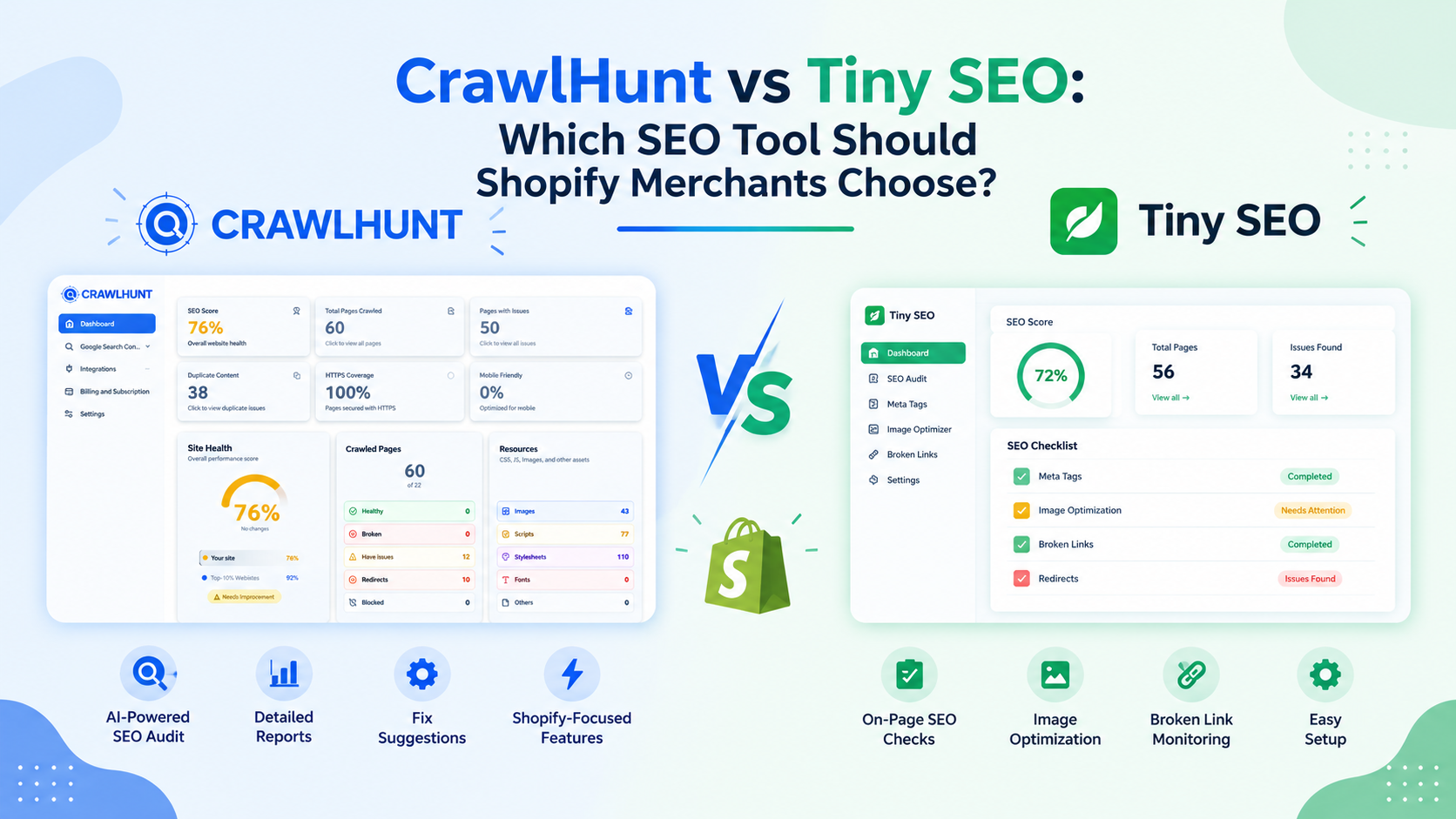
Choosing the right SEO app can make a major difference in how efficiently Shopify merchants manage technical issues, optimize product pages, improve search visibility, and automate repetitive SEO tasks. In the CrawlHunt vs Tiny SEO comparison, both tools are designed to simplify Shopify SEO, but they differ in their approach, feature depth, automation capabilities, and technical optimization options.
CrawlHunt focuses on areas such as SEO audits, bulk meta and ALT text optimization, redirects, canonical issues, schema, indexing, and performance improvements, while Tiny SEO offers its own set of optimization tools for Shopify stores. This comparison will help merchants understand the key differences and decide which solution better matches their SEO needs.
CrawlHunt vs Tiny SEO: Quick Comparison
When comparing CrawlHunt vs Tiny SEO, there is considerable overlap between the two platforms. Both can help Shopify merchants identify SEO problems, optimize metadata, work with images, manage redirects, improve site performance, and use AI to reduce repetitive optimization work.
The main difference is therefore not simply whether a particular feature exists. The more useful question is how each platform approaches SEO management.
Decision-Making Factor | CrawlHunt | Tiny SEO |
|---|---|---|
Full website SEO audit | Yes | Yes |
AI metadata optimization | Yes | Yes |
Bulk SEO editing | Yes | Yes |
Image ALT optimization | Yes | Yes |
Image compression | Yes | Yes |
404 detection | Yes | Yes |
Redirect management | Yes | Yes |
Canonical management | Strong focus | Less prominently positioned |
Structured data / Schema | Yes | Yes |
Core Web Vitals analysis | Dedicated focus | Page-speed optimization |
Google Search Console | Integrated into SEO workflow | Available, with advanced insights on higher plan |
IndexNow | Supported | Supported |
Sitemap management | Yes | Yes |
Robots.txt management | Yes | Not prominently positioned in current listing |
AI bulk fixes | Dedicated bulk-fix workflow | AI generation and automation |
Multiple website projects | Up to 10 or unlimited depending on plan | Primarily Shopify-store focused |
White-label reporting | Available on higher CrawlHunt plans | Reporting available |
Starting paid plan | $59/month Growth | $14/month Beginner |
Highest listed plan | $149/month Scale | $49/month Expert |
Shopify App Store rating | 5.0 | 5.0 |
CrawlHunt vs Tiny SEO: Detailed Feature Comparison
1. SEO Auditing and Issue Detection
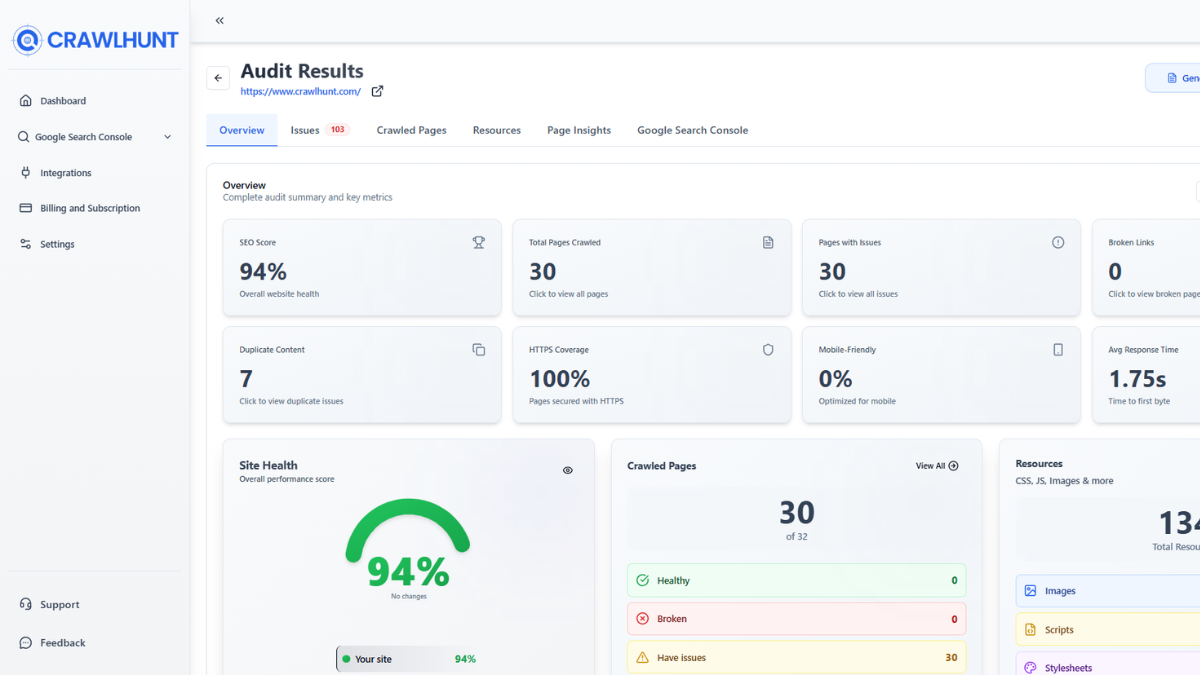
A good Shopify SEO application should do more than provide individual optimization tools. It should help merchants understand what is wrong with the store, where the problem exists, and what action should be taken next.
This is an important area in the CrawlHunt vs Tiny SEO comparison.
CrawlHunt is structured around a website-crawling workflow. Merchants can crawl their website and identify SEO issues affecting products, collections, blogs, pages, indexing, crawlability, metadata, links, structured data, and performance. The Shopify App Store listing specifically positions the platform around finding and fixing issues that affect search visibility, crawlability, indexing, and website performance.
Instead of opening different utilities for different SEO tasks, the merchant can begin with a technical SEO audit and use the results as a working SEO checklist.
For example, an audit may identify:
- Missing or poorly optimized meta titles
- Missing meta descriptions
- Images without ALT text
- Broken URLs
- 404 pages
- Redirect opportunities
- Duplicate content
- Canonical problems
- Structured-data issues
- Indexing problems
- Internal-link problems
- Website-performance concerns
Tiny SEO also provides advanced site auditing and SEO reports. Its current Shopify listing states that it can identify technical SEO issues across store pages and provides SEO scores, auditing, reporting, link analysis, content analysis, keyword analysis, rank tracking, and other monitoring capabilities.
The difference is mainly emphasis. Tiny SEO combines auditing with a broad suite of SEO, image, speed, and content tools, whereas CrawlHunt places the crawl → identify issue → investigate → fix → monitor process closer to the centre of the product.
For merchants who prefer to manage SEO as an ongoing technical health process rather than a collection of separate optimizations, that workflow can be useful.
2. Meta Titles and Meta Descriptions
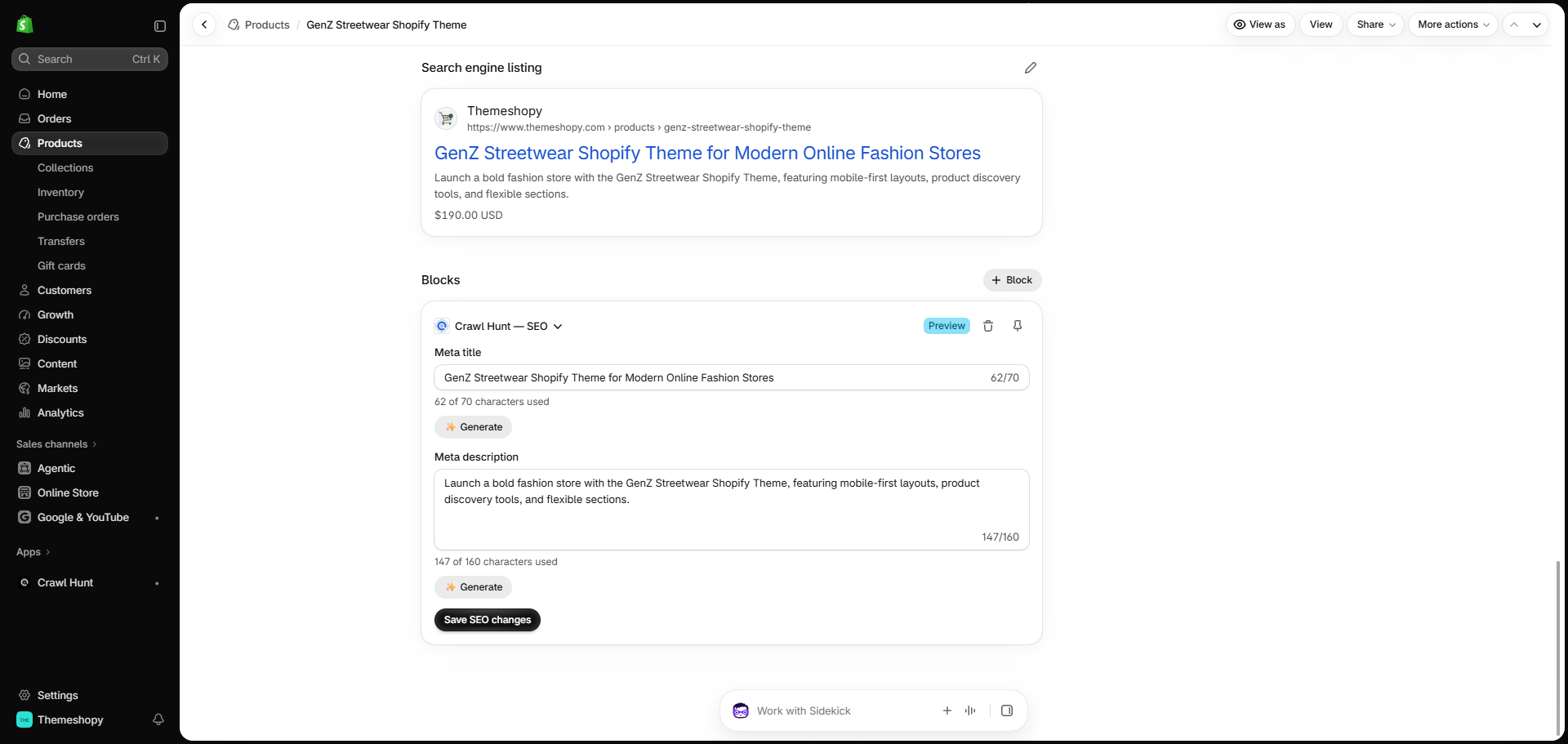
Metadata is one of the most repetitive SEO tasks in ecommerce.
A Shopify store with hundreds or thousands of products and collections can easily develop pages with:
- Missing meta titles
- Duplicate titles
- Titles that are too short or too long
- Missing descriptions
- Weak descriptions
- Repetitive metadata
- Metadata that does not adequately describe search intent
Both platforms provide AI-powered metadata capabilities.
Tiny SEO supports AI-generated SEO metadata as well as AI-generated product titles and descriptions. Automatic AI SEO metadata generation is included in its Advanced plan according to its current Shopify App Store listing.
CrawlHunt approaches the same problem through its SEO audit and fixing workflow.
After crawling the store, merchants can locate metadata-related issues and generate optimized titles or descriptions using AI. CrawlHunt also supports Bulk AI Fixes, allowing multiple SEO issues to be processed rather than requiring the merchant to optimize every page separately. Its Shopify listing currently provides 2,000 AI fixes per month on the Growth plan and unlimited AI fixes on the Scale plan.
This becomes particularly relevant for larger catalogs.
Instead of:
Product 1 → Edit → Generate → Save
Product 2 → Edit → Generate → Save
Product 3 → Edit → Generate → Save
the goal is closer to:
Crawl Store → Find Metadata Issues → Select Affected Pages → Bulk AI Fix → Review → Publish
That difference in workflow can become significant when hundreds of URLs require attention.
3. Image SEO and ALT Text Optimization

Image optimization is one of Tiny SEO's strongest and longest-established areas.
Tiny SEO allows merchants to compress images, resize dimensions, optimize filenames, generate ALT text, enable lazy loading, and manage image backups. Its current plans provide between 50 and 15,000 included monthly image optimizations depending on the subscription level.
For a merchant whose primary requirement is image compression and straightforward image SEO, Tiny SEO therefore presents a strong proposition.
CrawlHunt also supports:
- Image compression
- Image optimization
- ALT text optimization
- AI-generated ALT text
- Bulk editing
- Performance optimization
However, CrawlHunt places image issues within the broader technical SEO audit.
For example, a merchant can crawl the website, identify images without ALT text, open the relevant issue category, generate ALT descriptions with AI, and then apply those changes to the connected Shopify store.
The distinction is subtle but important.
Tiny SEO can be particularly attractive when image optimization is one of the main objectives, whereas CrawlHunt may appeal more to merchants who see image ALT text as one item within a wider site-wide technical SEO cleanup.
4. Broken Links, 404 Errors and Redirect Management
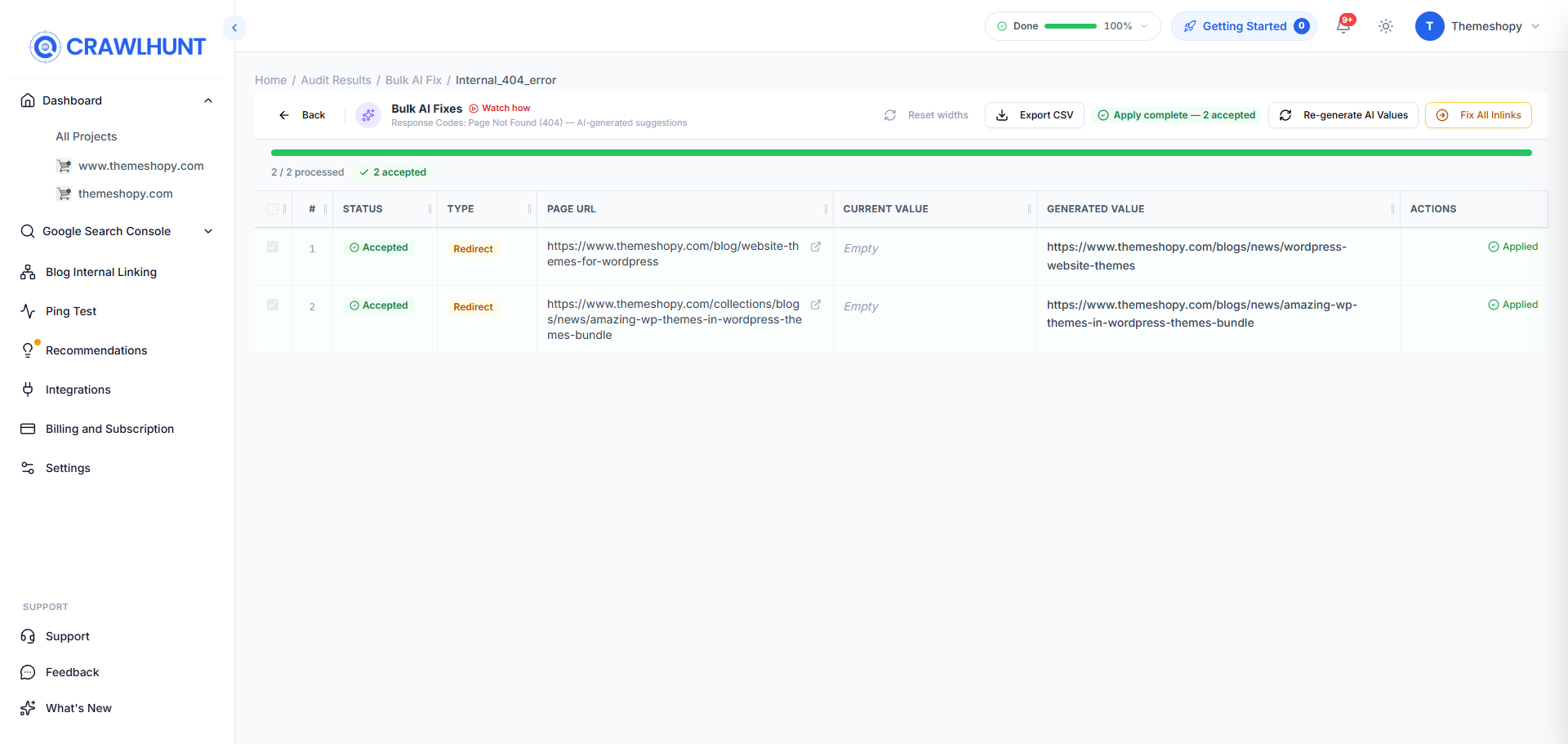
Broken URLs can negatively affect both users and search-engine crawling.
A discontinued product, changed collection URL or deleted page can create a 404 error. If those URLs have incoming links or internal links pointing toward them, traffic and link value can be lost.
Both apps provide tools in this area.
Tiny SEO detects broken links and provides 404 and 301 redirect management. Its Expert plan also includes automatic redirects when products are deleted.
CrawlHunt similarly includes:
- Broken-link detection
- 404 monitoring
- 301 and 302 redirects
- AI-assisted redirect recommendations
- Bulk redirect handling
- Link analysis
The CrawlHunt workflow can be especially useful when merchants need to fix 404 errors that have already built up across the store.
Instead of manually deciding the destination for every broken page, AI-assisted recommendations can help identify relevant replacement URLs. Merchants can then review those suggestions before implementing the redirect.
This is another example where CrawlHunt vs Tiny SEO is less about whether redirect functionality exists and more about how deeply the functionality is connected with the technical SEO audit.
5. Internal Link and Inlink Management
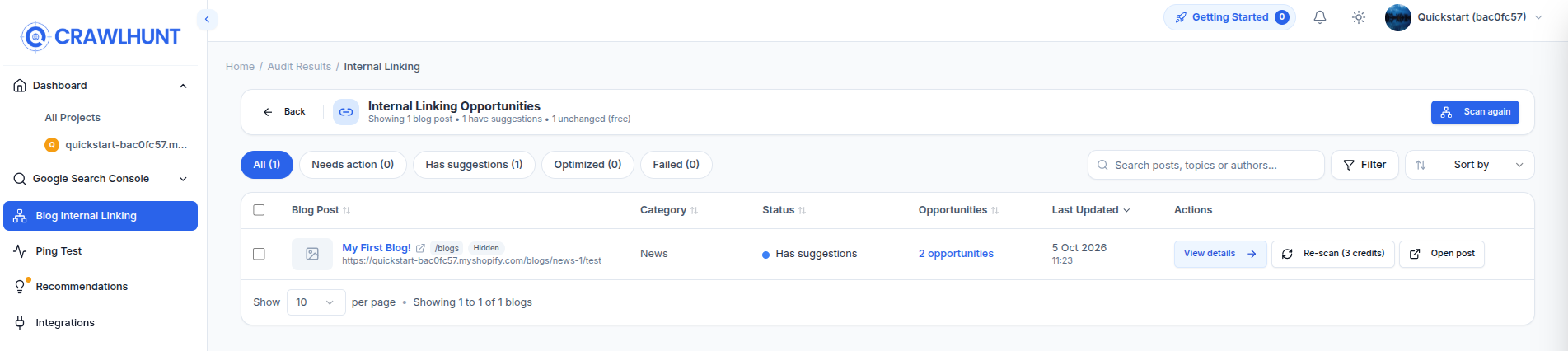
Fixing a redirect is only part of a broken-link problem.
Suppose a product URL has been removed and ten blog articles still contain links to the old URL. Creating a redirect protects visitors, but those internal links should ideally also be updated.
This is where CrawlHunt's technical crawling approach becomes useful.
The platform can analyze links across the website and help merchants understand which URLs are linking toward problematic pages. This makes it possible to address the source of the broken internal link, rather than depending indefinitely on the redirect.
For large ecommerce stores, this is particularly valuable because internal-link problems are difficult to identify manually.
Tiny SEO also lists broken-link detection, redirects and link analysis among its current capabilities.
However, merchants comparing the platforms should examine how much visibility they need into the actual link structure of their store. If identifying and fixing inlinks is part of your internal linking strategy, a crawler-oriented workflow becomes more important.
6. Canonical URL Management
Canonical tags tell search engines which version of a page should be considered the preferred URL when several similar or duplicate URLs exist.
This can be especially relevant for ecommerce websites because products can sometimes become accessible through multiple paths, filtering structures or URL variations.
CrawlHunt specifically lists canonical management as one of its technical SEO capabilities.
This allows merchants to review canonical tag issues as part of the technical audit instead of treating canonicalization as something that only developers should investigate.
For example, CrawlHunt can help merchants identify situations where:
- A canonical is missing
- A canonical points toward an unexpected URL
- Duplicate pages require investigation
- Search engines may receive conflicting indexing signals
Tiny SEO provides broad technical SEO auditing and structured-data functionality, but canonical management is not currently highlighted as prominently in its Shopify App Store feature description.
For stores dealing with duplicate URLs or more complicated crawlability issues, canonical visibility can therefore become a meaningful consideration in the CrawlHunt vs Tiny SEO decision.
7. Schema and Structured Data
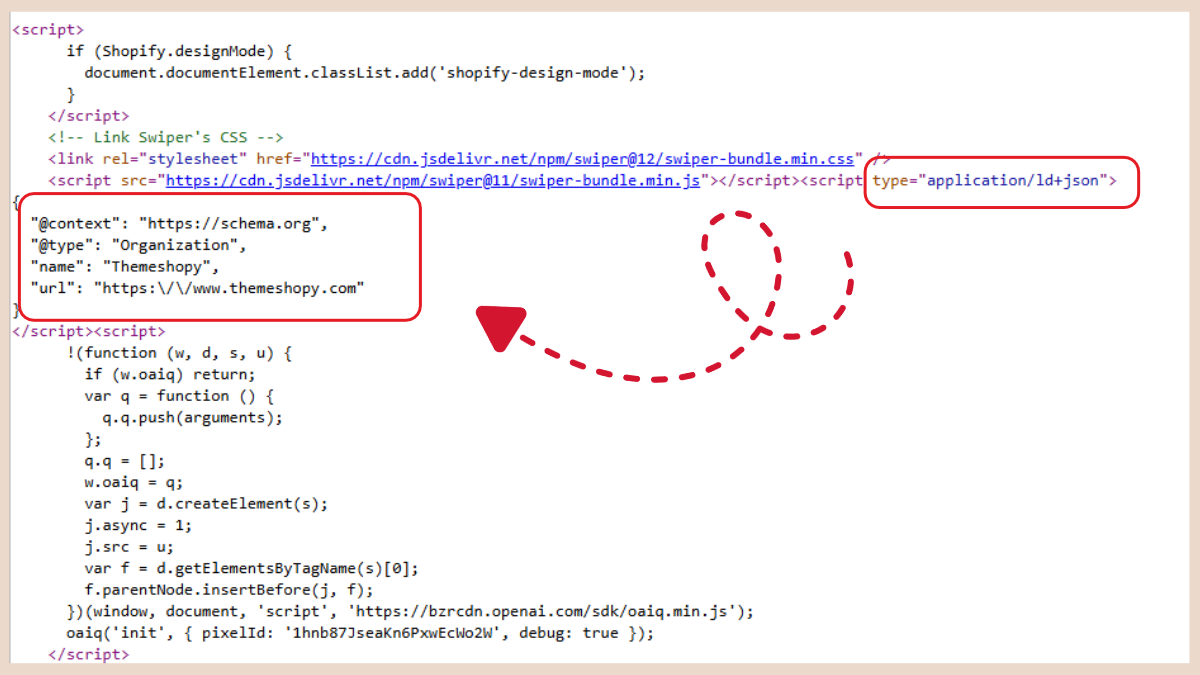
Structured data helps search engines better understand information such as products, businesses, breadcrumbs, reviews and other page elements.
Both applications provide schema-related features.
Tiny SEO includes JSON-LD structured data and offers extended JSON-LD functionality in its Expert plan.
CrawlHunt also supports structured data and schema management as part of its technical SEO toolkit.
For most Shopify merchants, the decision should therefore not simply be:
"Does the app provide schema?"
Instead, merchants should ask:
- What schema types can be managed?
- Can errors be detected?
- How much control is available?
- Is schema part of the wider audit?
- Can structured-data issues be monitored over time?
CrawlHunt's benefit here is that schema sits alongside canonicals, redirects, indexing, crawlability and other technical SEO issues rather than operating as an isolated feature.
8. Google Search Console and Indexing

Search Console is one of the most useful sources of SEO information because it shows how Google interacts with and discovers a website.
Both tools offer Google Search Console integration.
Tiny SEO's Expert plan currently includes advanced Google Search Console insights, while the platform also supports IndexNow for quicker submission to supported search engines.
CrawlHunt integrates Google Search Console into its SEO workflow and lists:
- Google Search Console integration
- Sitemap management
- Page indexing
- Robots.txt management
- Indexing management
- Search visibility monitoring
as parts of its platform.
This is important because finding an SEO issue and understanding whether Google can properly discover or index the affected page are closely related tasks.
A more connected workflow might look like:
Crawl Website → Identify SEO Error → Fix Error → Review Sitemap/Indexing → Monitor Search Console
rather than using separate utilities for each stage.
For technical SEO teams and merchants who regularly investigate indexing problems, this centralization can make CrawlHunt useful beyond basic on-page optimization.
9. IndexNow and Faster URL Discovery
Both CrawlHunt and Tiny SEO support IndexNow-related workflows.
Tiny SEO explicitly supports IndexNow for Bing and other participating search engines.
CrawlHunt also provides indexing tools designed to help merchants notify supported search engines about updated or newly published URLs.
It is worth noting that IndexNow should not be confused with guaranteed Google indexing. It is primarily a URL-change notification protocol supported by participating search engines.
For frequently changing ecommerce stores, however, quicker URL discovery can still be useful when products, collections and content are regularly added, removed or updated.
10. Core Web Vitals and Website Performance
SEO is increasingly connected with user experience and website performance.
Tiny SEO provides several direct performance tools, including:
- Image compression
- Image resizing
- Lazy loading
- Asset preloading
- CSS minification
- JavaScript minification
- Page-speed optimization
These features make Tiny SEO particularly strong for merchants primarily trying to reduce image weight and improve Shopify storefront performance.
CrawlHunt also addresses website performance, but takes a diagnostic approach through Core Web Vitals analysis and optimization.
The platform evaluates website performance as part of the broader SEO health of the store and lists Core Web Vitals and website-performance optimization among its primary capabilities.
That can help merchants examine important performance signals through Core Web Vitals monitoring alongside technical SEO rather than treating page speed as a completely separate task.
Therefore:
Tiny SEO: strong direct performance and image optimization toolkit.
CrawlHunt: performance analysis integrated with a broader technical SEO audit and fixing workflow.
The more suitable approach depends on whether the merchant is primarily searching for a speed optimizer or a technical SEO platform where performance is one part of overall website health.
11. AI SEO Automation and Bulk Fixes

AI has become common in Shopify SEO applications, so merely offering an AI generator is no longer a major differentiator.
The more important question is how AI is incorporated into the workflow.
Tiny SEO uses AI for metadata generation, ALT text, content optimization, blog creation and other SEO tasks. It also provides automation capabilities for merchants who prefer a more hands-off approach.
CrawlHunt uses AI around detected SEO problems.
For example:
Audit → Detect issue → Select URLs → Generate AI fix → Review → Save changes
Its Growth plan currently provides 2,000 AI fixes per month, while its Scale plan lists unlimited AI fixes and bulk AI fixes.
This is particularly relevant for merchants with large product catalogs.
If 500 products have missing ALT text or hundreds of pages require metadata improvements, the merchant is not necessarily looking for an AI writer. They are looking for a system capable of identifying the affected URLs and processing those issues efficiently.
That distinction is one of the stronger arguments for considering CrawlHunt.
12. Automated Monitoring
SEO problems do not occur only once.
New products are created, old products are removed, URLs change, apps modify themes, content gets published and developers update storefront code. Consequently, a store that is technically healthy today may develop new problems later.
CrawlHunt's plans include automated monitoring:
- Free: weekly automated monitoring
- Growth: daily automated monitoring
- Scale: real-time monitoring and alerts
This changes SEO from a one-time audit into an ongoing maintenance process.
For growing Shopify stores or agencies, that can be more practical than manually remembering to run another audit every few weeks.
Tiny SEO also provides automated site audits and several automation features, so merchants wanting a highly automated Shopify-native setup should not overlook it.
The distinction again comes down to the operating model: CrawlHunt increasingly behaves like an ongoing website SEO monitoring platform, while Tiny SEO combines monitoring with an extensive Shopify-focused optimization toolkit.
Which Type of Store Should Consider CrawlHunt?
CrawlHunt may be particularly suitable for Shopify stores that:
- Have hundreds or thousands of URLs
- Regularly add or remove products
- Have accumulated 404 errors
- Need bulk metadata optimization
- Want AI-assisted redirect workflows
- Need stronger visibility into canonical issues
- Want Search Console integrated into the SEO process
- Regularly investigate crawlability and indexing
- Want Core Web Vitals alongside technical SEO analysis
- Need recurring SEO monitoring
- Manage several website projects
- Require white-label SEO reporting
- Want AI to help resolve detected issues rather than simply generate content
For these businesses, the value is less about having the longest list of SEO features and more about having a structured system for finding and resolving problems at scale.
Which Type of Store Should Consider Tiny SEO?
Tiny SEO can make more sense for merchants who:
- Want a lower-cost paid entry point
- Place strong emphasis on image optimization
- Need image resizing and backup
- Want straightforward page-speed improvements
- Want AI blog generation
- Need SEO-friendly image filenames
- Prefer an established Shopify app with thousands of reviews
- Want multiple SEO and performance tools in one Shopify-focused package
Its current Shopify App Store offering is broad enough that many smaller and medium-sized merchants may not require anything more complicated.
Conclusion
The CrawlHunt vs Tiny SEO comparison shows that both tools can support Shopify merchants with SEO automation, metadata optimization, image SEO, redirects, and technical improvements. Tiny SEO is a strong option for merchants focused on image optimization, speed, and straightforward SEO automation, while CrawlHunt offers a more audit-driven approach with technical SEO monitoring, bulk AI fixes, indexing tools, canonical management, redirects, and Core Web Vitals analysis.
The right choice depends on your store size, SEO complexity, and workflow. Merchants managing larger stores or more technical SEO challenges may find CrawlHunt's centralized approach especially useful.
FAQs
1. What is the main difference between CrawlHunt and Tiny SEO?
The main difference is their approach. Tiny SEO focuses strongly on image optimization, speed, and general SEO automation, while CrawlHunt emphasizes technical SEO auditing, issue detection, bulk fixes, indexing, redirects, canonicals, and ongoing monitoring.
2. Is CrawlHunt suitable for large Shopify stores?
Yes. CrawlHunt can be useful for larger stores because it supports website crawling, bulk AI fixes, redirect management, metadata optimization, technical SEO monitoring, and multi-project management.
3. Does Tiny SEO support technical SEO?
Yes. Tiny SEO includes site audits, redirects, structured data, broken-link detection, Search Console insights, and several performance optimization features.
4. Can CrawlHunt fix SEO issues in bulk?
Yes. CrawlHunt provides bulk AI workflows for tasks such as metadata, ALT text, redirects, and other SEO issues, allowing merchants to work on multiple affected URLs more efficiently.
5. Which is better for Shopify SEO: CrawlHunt or Tiny SEO?
It depends on your requirements. Tiny SEO can suit merchants prioritizing image and speed optimization, while CrawlHunt may be more suitable for stores needing deeper technical SEO auditing, automation, indexing, and ongoing site monitoring.