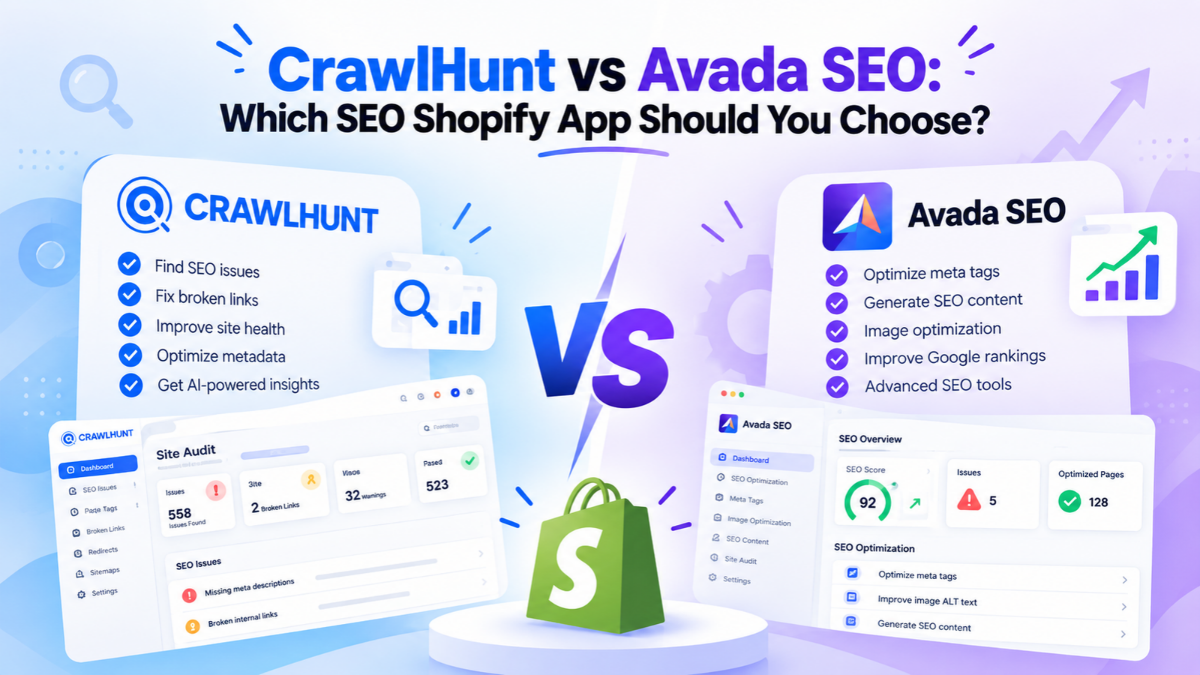
Choosing the right SEO app can make a significant difference in how efficiently you optimize your Shopify store, fix technical issues, and improve search visibility. CrawlHunt vs Avada SEO is a useful comparison for merchants exploring the best Shopify SEO apps and looking for automation, technical SEO tools, image optimization, metadata management, redirects, and performance improvements. While both apps are designed to simplify Shopify SEO, they differ in features, workflows, and the level of automation they provide.
In this comparison, we will explore their key capabilities, SEO tools, usability, and overall approach to store optimization so you can better understand which solution aligns with your Shopify store's SEO requirements and long-term growth strategy.
CrawlHunt vs Avada SEO: Quick Comparison
When comparing CrawlHunt vs Avada SEO, the biggest difference is not simply the number of SEO features each app offers. Both platforms cover important areas of Shopify SEO, but they approach optimization differently.
Avada SEO is an established Shopify SEO solution with a strong focus on image optimization, speed improvement, structured data, metadata, on-page audits, and general store optimization. CrawlHunt takes a broader technical SEO approach by combining full-site crawling, issue detection, AI-assisted fixes, redirects, canonical management, structured data, Core Web Vitals, indexing tools, Google Search Console integration, and automated SEO monitoring within the same workflow.
Here is a quick look at some of the major decision-making differences based on their current Shopify App Store listings as of October 2026.
Decision Factor | CrawlHunt | Avada SEO |
|---|---|---|
Free Plan | Yes | Yes |
Starting Paid Plan | $59/month | $34.95/month |
Higher Plan | $149/month | $99/month |
Full Website Crawl | Yes | On-page auditing |
AI Allowance on Main Paid Plan | 2,000 AI fixes/month | 1,000 AI credits |
Bulk AI Fixes | Yes | AI optimization available |
Core Web Vitals | Analysis + optimization | Speed booster |
Automated Monitoring | Daily on Growth; real-time on Scale | SEO audits/analysis |
Broken Link Management | Yes | Yes |
Redirect Management | Yes | Yes |
Canonical Management | Explicitly included | Not highlighted as a core listing feature |
Structured Data | Yes | Yes |
Google Search Console | Explicit integration | Not highlighted as a core listing feature |
Sitemap / Robots.txt | Yes | Yes |
White-Label Reports | Growth and Scale | Not highlighted as a core listing feature |
Image Optimization | Yes | Strong focus |
Shopify App Store Rating | 5.0 from 3 reviews | 4.9 from 4,680 reviews |
An important point is that AI fixes and AI credits are not necessarily equivalent units, so the numbers should not be compared as if one credit always equals one completed SEO fix.
Avada SEO also has a significantly longer track record on the Shopify App Store, with thousands of reviews compared with CrawlHunt's much smaller review base. For merchants who heavily value marketplace history and social proof, this is an important advantage for Avada SEO.
However, merchants evaluating an SEO platform based primarily on technical SEO workflow rather than app longevity may find some meaningful differences between the two.
1. Website Crawling and SEO Issue Discovery

One of the first differences in the CrawlHunt vs Avada SEO comparison is how each platform approaches discovering SEO problems.
CrawlHunt is built around a website-crawling workflow. After connecting a Shopify store, merchants can crawl their website and identify SEO issues affecting products, collections, blogs, custom pages, links, metadata, indexing, structured data, and website performance.
Instead of requiring the merchant to already know which pages need optimization, the crawl acts as the starting point of a technical SEO audit.
The general workflow becomes:
Crawl the website → discover SEO issues → review affected URLs → apply manual or AI-assisted fixes → monitor the website again.
This can become particularly useful as a Shopify store grows. A store containing hundreds or thousands of URLs becomes increasingly difficult to check manually.
CrawlHunt's current Shopify listing specifically includes full website crawling on all plans. The free plan allows merchants to view up to 25 SEO issues, while paid plans provide unlimited issue visibility.
Avada SEO, meanwhile, provides on-page SEO audits and an AI-powered auditing workflow. Its free plan currently includes 20 on-page audits, while its Pro plan provides unlimited on-page audits.
Therefore, both platforms help identify SEO problems, but their workflows emphasize somewhat different use cases.
CrawlHunt is particularly oriented toward merchants who want to treat their Shopify store as a website that needs to be continuously crawled and technically monitored rather than simply optimizing individual SEO elements.
2. AI SEO Fixes and Bulk Optimization
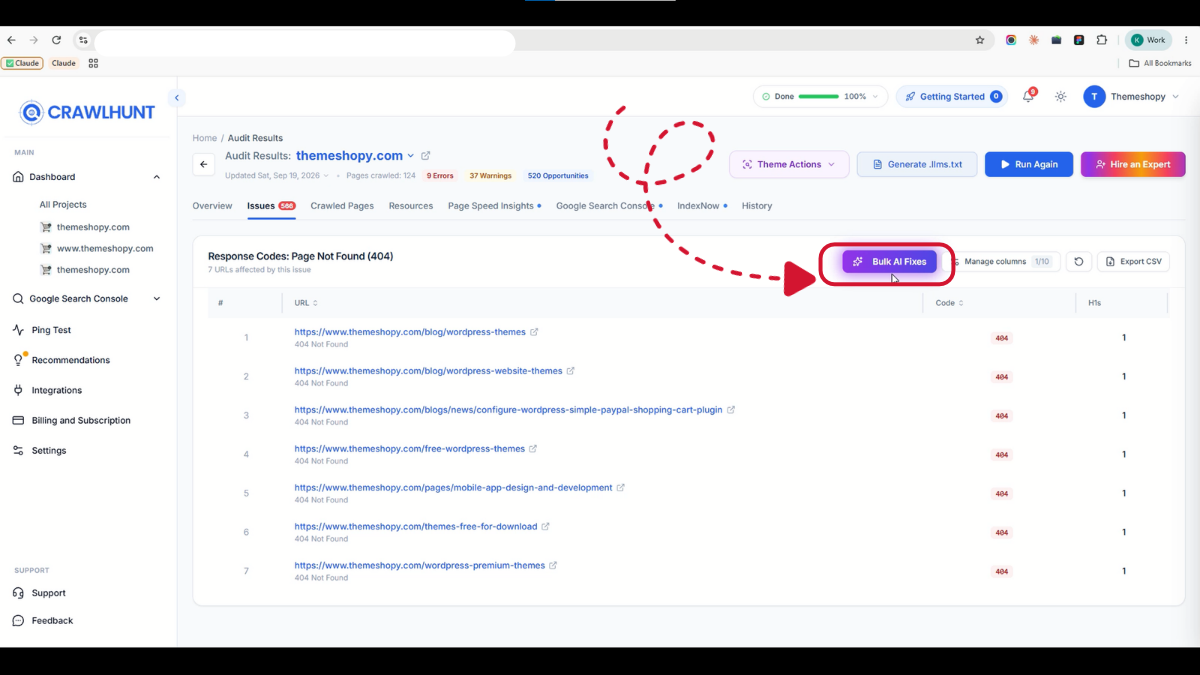
AI has become increasingly common in Shopify SEO apps, and both CrawlHunt and Avada SEO use AI to reduce repetitive work.
The important question, however, is not simply whether an app has AI. Merchants should consider where AI is integrated into the optimization workflow.
CrawlHunt combines issue discovery with AI-assisted remediation. Once an issue has been identified during the crawl, merchants can review affected URLs and use AI-assisted or bulk actions where supported.
For example, instead of manually opening dozens or hundreds of Shopify products that have incomplete metadata, merchants can identify the issue through the SEO audit and work through the affected pages in bulk.
CrawlHunt's Growth plan currently includes:
- 2,000 AI fixes per month
- Bulk AI fixes
- 10,000 manual fixes per month
- Unlimited SEO issue visibility
- Daily automated monitoring
Its Scale plan extends this to unlimited AI fixes and unlimited manual fixes.
Avada SEO also provides AI capabilities. Its current Pro plan includes 1,000 AI credits, while the Enterprise plan includes 10,000 AI credits and an AI on-page audit agent.
This makes both applications relevant for merchants who want to use AI for SEO.
CrawlHunt's distinction is that AI sits within a broader crawl → identify → fix → monitor workflow, which can make it particularly useful when the objective is to resolve SEO problems across an entire store rather than generate individual SEO elements.
3. Technical SEO Capabilities
This is one of the more important areas to examine when comparing CrawlHunt with Avada SEO.
Shopify SEO is not limited to keywords, titles, descriptions, or image ALT text. Search visibility can also be influenced by issues involving:
- Broken URLs
- Redirect chains
- Canonical URLs
- Duplicate content
- Structured data
- Sitemap accessibility
- robots.txt
- Search engine indexing
- Internal links
- Core Web Vitals
- Website performance
CrawlHunt's Shopify App Store listing specifically positions the platform around technical SEO and includes broken links, redirects, 404 pages, canonical management, structured data, page indexing, sitemap management, robots.txt management, Core Web Vitals, and URL optimization.
This gives CrawlHunt a strong technical SEO orientation.
Rather than treating technical SEO as a separate task requiring several different tools, the idea is to make these issues visible through the same dashboard merchants use for their general SEO work.
Avada SEO also provides several important technical features. Its Pro plan includes broken-link management, URL optimization, an XML sitemap generator, robots.txt editing, structured data, and speed optimization.
Consequently, it would be inaccurate to describe Avada SEO as only an image or metadata optimizer. It has developed into a much broader SEO suite.
The difference is primarily one of emphasis.
Avada SEO has a broad Shopify optimization toolkit, while CrawlHunt places particularly strong emphasis on crawling, technical SEO issue discovery, remediation, and monitoring.
4. 404 Errors, Broken Links and Redirects
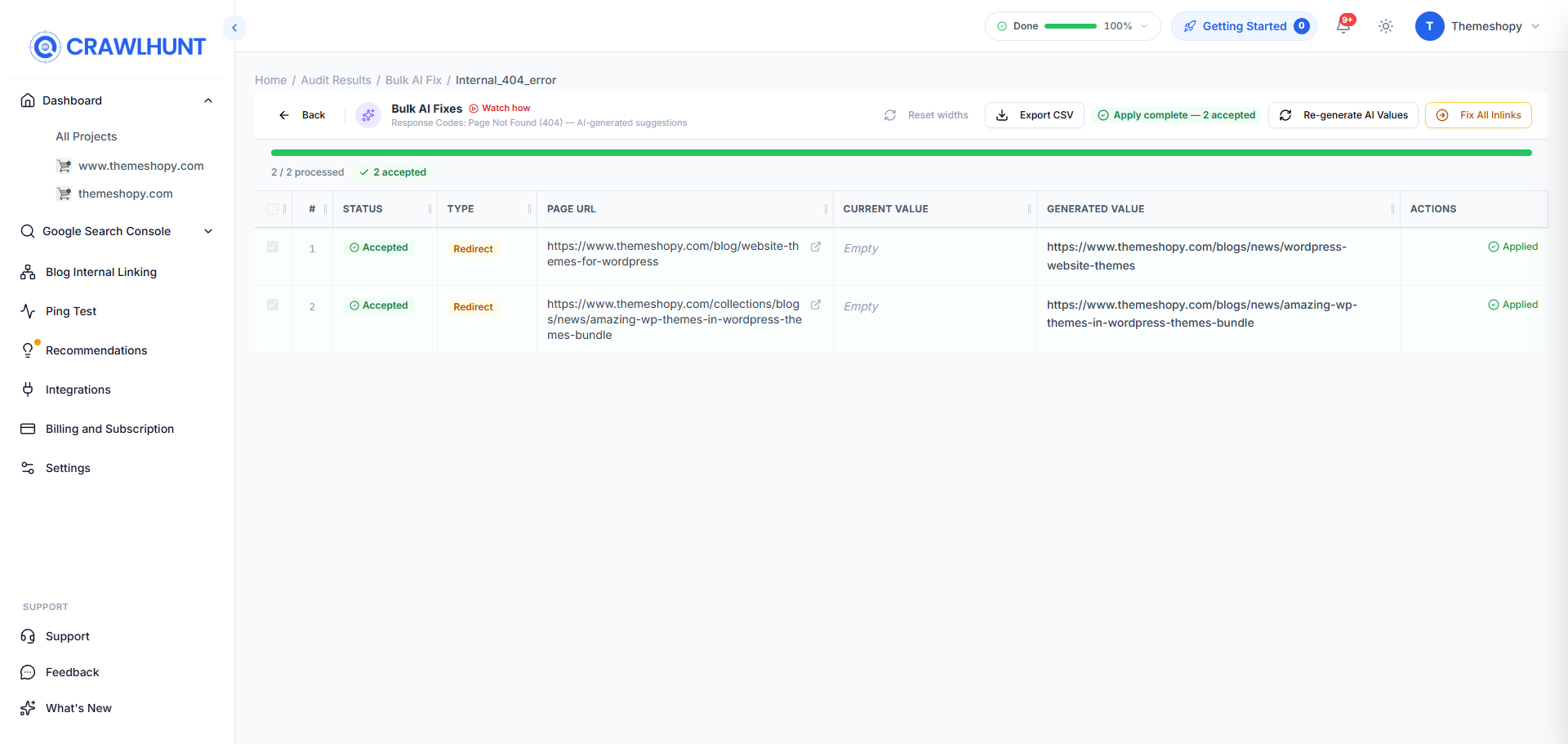
Broken links are especially important for established Shopify stores.
Products are discontinued. Collections change. URLs are modified. Campaign landing pages disappear. Blog URLs get updated.
Over time, this can create 404 errors, which is why knowing how to fix 404 errors quickly becomes an important part of store maintenance.
A few broken URLs may be manageable manually, but stores that frequently change their catalogue can accumulate significantly more.
Both CrawlHunt and Avada SEO offer broken-link and URL-management functionality. Avada SEO includes a broken-link manager and URL optimization on its Pro plan.
CrawlHunt approaches the same issue as part of its larger technical SEO audit.
Merchants can identify broken URLs, manage redirects, and work through SEO issues discovered during crawling. CrawlHunt's Shopify listing explicitly includes broken links, redirects, 404 pages, URL optimization, and indexing management.
This becomes more useful when broken links are not treated as isolated errors but as part of the website's overall crawlability.
For merchants operating frequently changing catalogues, redirect management may therefore be one of the more meaningful areas to examine when choosing between CrawlHunt and Avada SEO.
5. Canonical URLs and Duplicate Content
Duplicate and similar URLs can create additional complexity for ecommerce SEO.
Shopify stores naturally contain products, collections, tags, filters, and various routes through which users and search engines can reach similar content.
Canonical tags help communicate which URL should be treated as the preferred version, and unresolved canonical tag issues can split ranking signals across similar pages.
CrawlHunt specifically highlights canonical management and duplicate-content analysis within its current Shopify SEO feature set.
For merchants working on deeper technical SEO, having canonical information alongside redirects, broken links, indexing information, and crawl data can make diagnosis considerably easier.
Rather than evaluating canonical URLs separately, merchants can review them as another component of overall site health.
Avada SEO's Shopify listing focuses heavily on structured data, metadata, broken links, URLs, sitemaps, robots.txt, image SEO, and speed optimization. Canonical management is not currently highlighted as prominently in its Shopify App Store feature description.
That does not necessarily mean Avada SEO has no canonical-related functionality; it simply means merchants specifically prioritizing canonical management should check the current capabilities of each application before deciding.
6. Google Search Console and Indexing
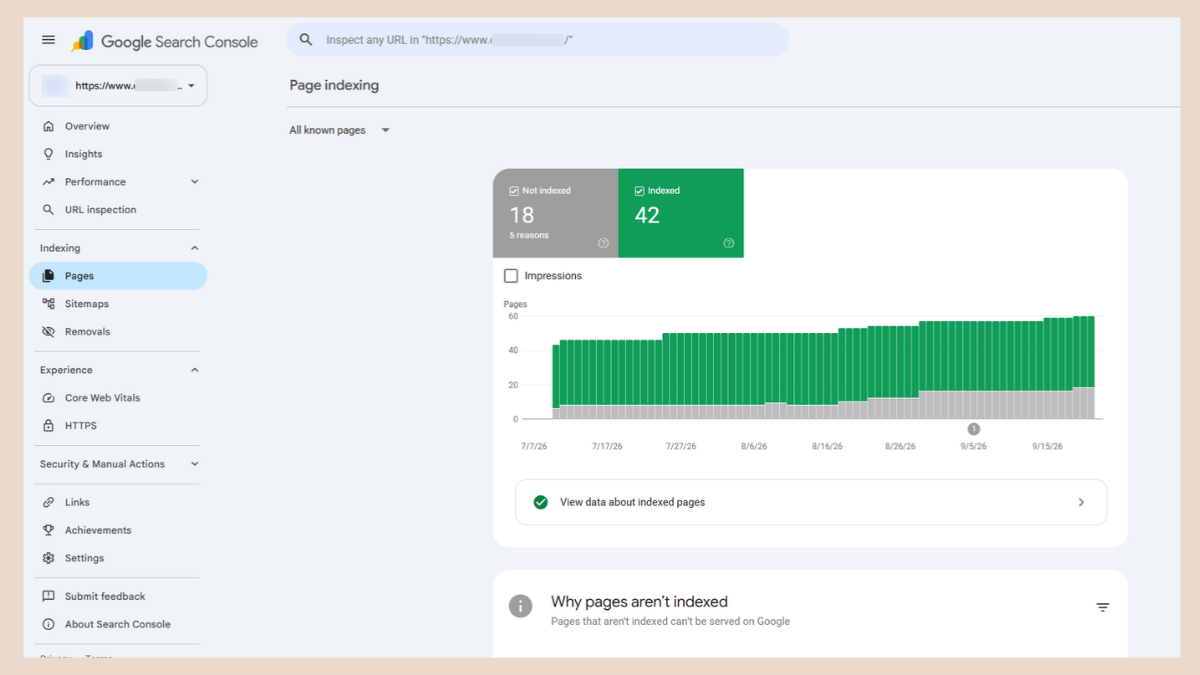
Finding an SEO issue and fixing it is only part of technical SEO.
Merchants also need to understand how search engines are discovering and indexing their pages.
This is an area where CrawlHunt attempts to connect website optimization more closely with search-engine visibility.
Its Shopify listing specifically highlights Google Search Console integration, sitemap, robots.txt, and indexing management as part of the platform.
The benefit of this approach is workflow consolidation.
Instead of thinking about SEO as separate activities such as:
SEO Audit
then
Technical Fixes
then
Google Search Console
then
Indexing
CrawlHunt aims to bring more of these activities into a connected SEO workflow.
For technical SEO teams, agencies, or merchants who regularly inspect indexing problems, this may be an important consideration when evaluating CrawlHunt against Avada SEO.
7. Core Web Vitals and Website Performance
Website speed is another area where both applications provide functionality.
Avada SEO has traditionally placed considerable emphasis on image and performance optimization. Its current plans include Basic, Turbo, and Rocket speed boosters depending on the subscription level.
It also provides extensive image optimization capabilities, including compression, resizing, format conversion, ALT text generation, and bulk editing.
This makes Avada SEO particularly relevant for merchants whose primary concern is image-heavy Shopify stores and straightforward performance optimization.
CrawlHunt approaches performance from a technical auditing perspective, with Core Web Vitals monitoring built into its wider workflow.
Its free plan includes Core Web Vitals analysis, while the Growth plan includes Core Web Vitals optimization. The application also lists speed analysis, image optimization, lazy loading, compression, and performance optimization among its available SEO tools.
The distinction is therefore subtle but important.
Avada SEO provides a particularly mature image and speed optimization toolkit, while CrawlHunt connects performance metrics more closely with its broader technical SEO auditing environment.
A merchant primarily looking to compress thousands of images may therefore evaluate the apps differently from an SEO manager trying to monitor technical health across the entire store.
8. Structured Data and Schema Markup
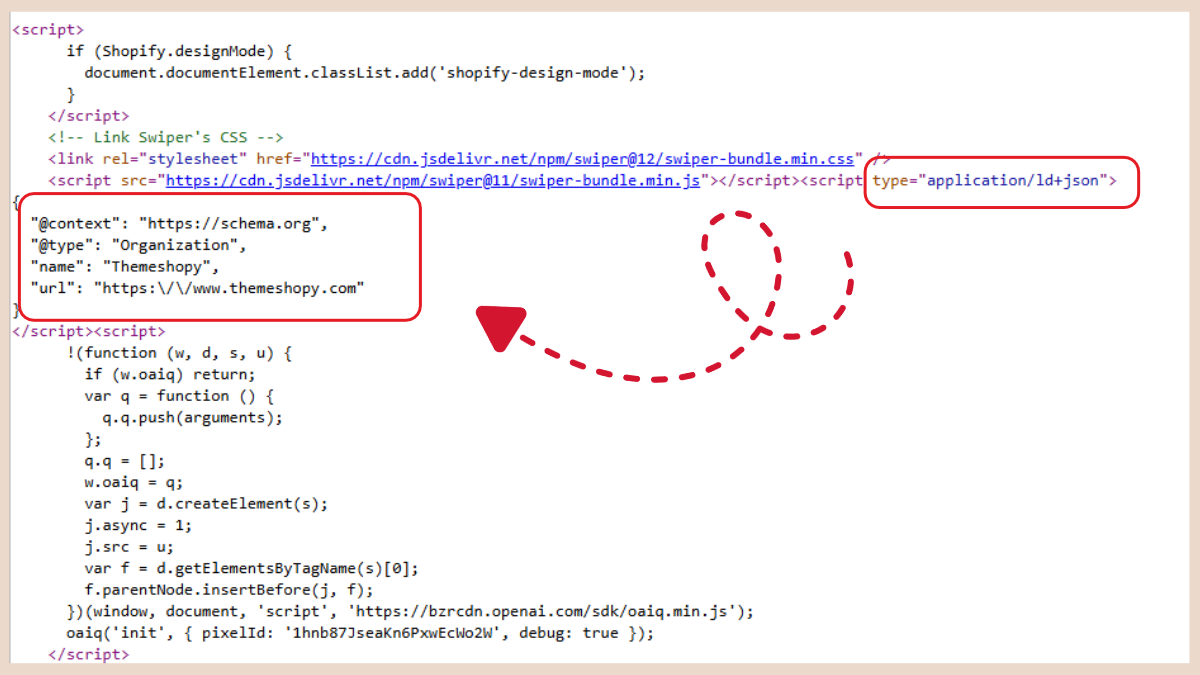
Structured data, often discussed as schema markup for SEO, helps search engines better understand information about products and other website content.
Both CrawlHunt and Avada SEO support structured data.
Avada SEO offers different structured-data levels across its plans:
- Basic Google Structured Data on Free
- Pro Google Structured Data on Pro
- Advanced Google Structured Data on Enterprise
CrawlHunt also includes JSON-LD, schema, and structured-data management among its Shopify SEO capabilities.
Because both applications cover this area, structured data alone may not be enough to determine which app is appropriate.
Merchants should instead examine structured data alongside the rest of their workflow: auditing, technical issue detection, indexing, redirects, page optimization, and monitoring.
9. Image SEO: An Area Where Avada SEO Is Particularly Strong
A balanced CrawlHunt vs Avada SEO comparison should also recognize where Avada SEO has a clear emphasis.
Image optimization is one of those areas.
The current Avada SEO listing includes:
- Automatic image optimization
- Image compression
- Image quality control
- AI ALT text
- Bulk ALT editing
- File-name editing
- Format conversion
- Resizing
Together, its AI ALT text and bulk editing tools work as a capable AI image alt text generator alongside compression and resizing.
Its free plan currently includes optimization for 100 images, while its Pro plan offers unlimited image optimization.
CrawlHunt also supports image optimization, ALT text, AI generation, compression, and lazy loading, but image management is only one component of its wider SEO platform.
Therefore, a Shopify merchant whose biggest problem is simply optimizing a large product-image library may find Avada SEO's image-focused workflow attractive.
A merchant whose requirements extend from images into crawling, redirects, canonicals, indexing, monitoring, and technical SEO may place greater weight on CrawlHunt's broader workflow.
10. SEO Monitoring: Fixing Problems Once vs Continuously Watching the Store
SEO optimization should not necessarily be treated as a one-time exercise.
Shopify stores constantly change.
New products are published, old products are removed, collections change, URLs are modified, apps inject code, images are uploaded, and new pages are created.
A store that has no major technical issues today can develop new problems several weeks later.
This is why monitoring is an important part of CrawlHunt's approach.
Its current plans provide:
- Free: Weekly automated monitoring
- Growth: Daily automated monitoring
- Scale: Real-time monitoring and alerts
This shifts the workflow from:
Run SEO audit → fix problems → forget about it
toward:
Crawl → identify → fix → monitor → identify new issues → fix again
For growing Shopify stores, this continuous approach can become more valuable as the number of products, collections, blogs, landing pages, and URLs increases.
11. Reporting and Agency Use
Another difference becomes relevant for agencies, consultants, and teams managing several websites.
CrawlHunt's Growth plan currently supports up to 10 website projects, while the Scale plan supports unlimited website projects and unlimited team members.
Growth and Scale also include white-label reporting, with PDF and CSV reporting available on Growth.
This means CrawlHunt is not limited strictly to optimizing one Shopify storefront.
Its structure can also suit users who need a technical SEO platform across multiple projects.
Avada SEO's Shopify offering is more closely centered on Shopify store optimization, with its Enterprise tier adding one-on-one consulting, advanced structured data, higher AI allowances, and expert support.
For a single Shopify store, these differences may be less important.
For an agency or SEO professional responsible for multiple websites, they can become a significant part of the decision.
12. Pricing: Avada SEO Is Less Expensive at the Entry Paid Level
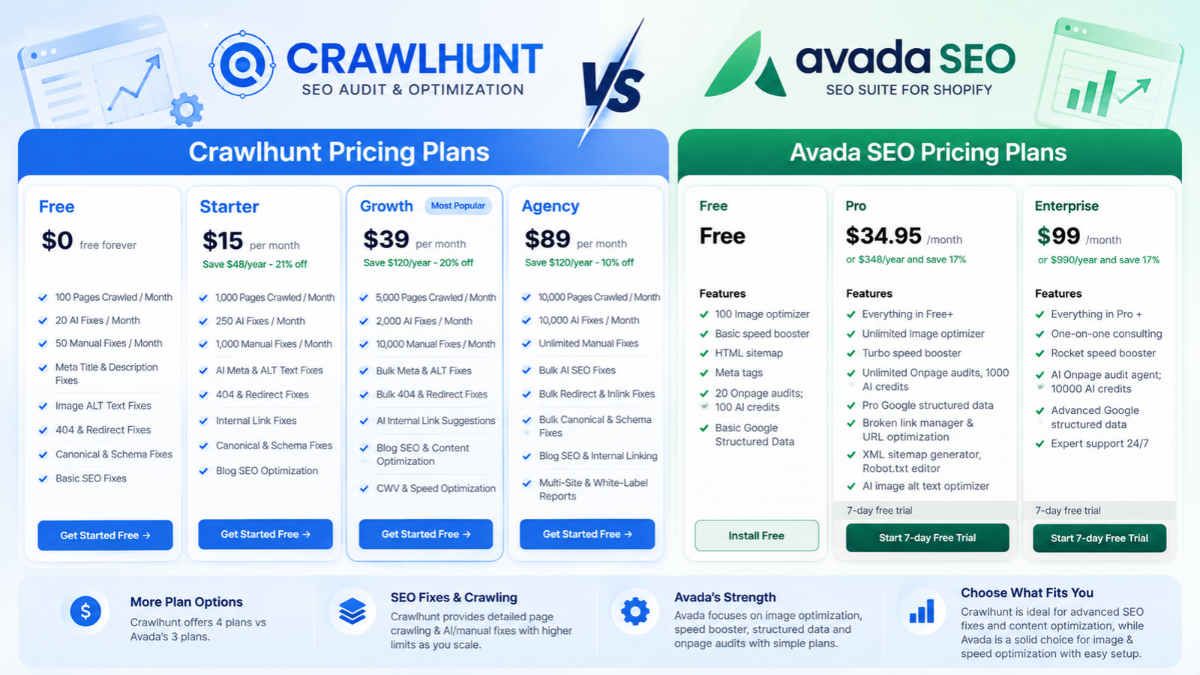
Price should also be included in a fair comparison.
As of October 2026, Avada SEO Pro starts at $34.95 per month, while CrawlHunt Growth starts at $59 per month.
Therefore, CrawlHunt should not be positioned simply as the cheaper alternative, because at the primary paid tier it is not.
The question is instead what a merchant receives for the additional cost.
CrawlHunt Growth currently includes:
- 10 website projects
- Full website crawling
- Unlimited SEO issue visibility
- 2,000 AI fixes per month
- Bulk AI fixes
- 10,000 manual fixes
- Core Web Vitals optimization
- Daily monitoring
- White-label PDF and CSV reporting
Avada SEO Pro currently includes:
- Unlimited image optimization
- Turbo speed booster
- Unlimited on-page audits
- 1,000 AI credits
- Pro structured data
- Broken-link management
- URL optimization
- XML sitemap generation
- robots.txt editing
- AI image ALT optimization
The better value therefore depends heavily on what problem the merchant is trying to solve.
If image optimization and general on-page SEO are the priority, Avada SEO provides a lower-priced paid entry point.
If full-site crawling, technical SEO, bulk remediation, multiple projects, reporting, and continuous monitoring are central requirements, CrawlHunt's higher-priced plan provides a different set of capabilities.
Conclusion
Choosing between CrawlHunt vs Avada SEO depends on how deeply you want to manage Shopify SEO. Avada SEO is a strong option for merchants focused on image optimization, metadata, speed, and general on-page improvements. CrawlHunt takes a broader technical approach by combining website crawling, SEO issue detection, bulk AI fixes, redirects, canonical management, indexing, Core Web Vitals, and continuous monitoring.
For growing stores and SEO teams that need greater visibility into technical issues and want to manage optimization from one workflow, CrawlHunt can be a practical alternative to Avada SEO.
FAQs
1. What is the main difference between CrawlHunt and Avada SEO?
Avada SEO focuses strongly on image optimization, speed, metadata, structured data, and on-page SEO, while CrawlHunt places greater emphasis on full-site crawling, technical SEO, issue detection, bulk fixes, indexing, redirects, and continuous monitoring.
2. Is CrawlHunt a good alternative to Avada SEO?
Yes. CrawlHunt can be a useful alternative for Shopify merchants who want more focus on technical SEO, website crawling, automation, monitoring, and bulk issue resolution.
3. Does CrawlHunt support AI SEO fixes?
Yes. CrawlHunt supports AI-assisted SEO fixes and bulk optimization for areas such as metadata, ALT text, redirects, and other supported SEO issues.
4. Does Avada SEO help improve Shopify speed?
Yes. Avada SEO includes image optimization and speed-enhancement features that can help merchants improve store performance and reduce the impact of heavy images and other performance issues.
5. Which app is better for technical Shopify SEO?
Both apps provide SEO tools, but CrawlHunt is more focused on technical workflows such as crawling, canonical management, redirects, indexing, Core Web Vitals, issue monitoring, and bulk remediation.