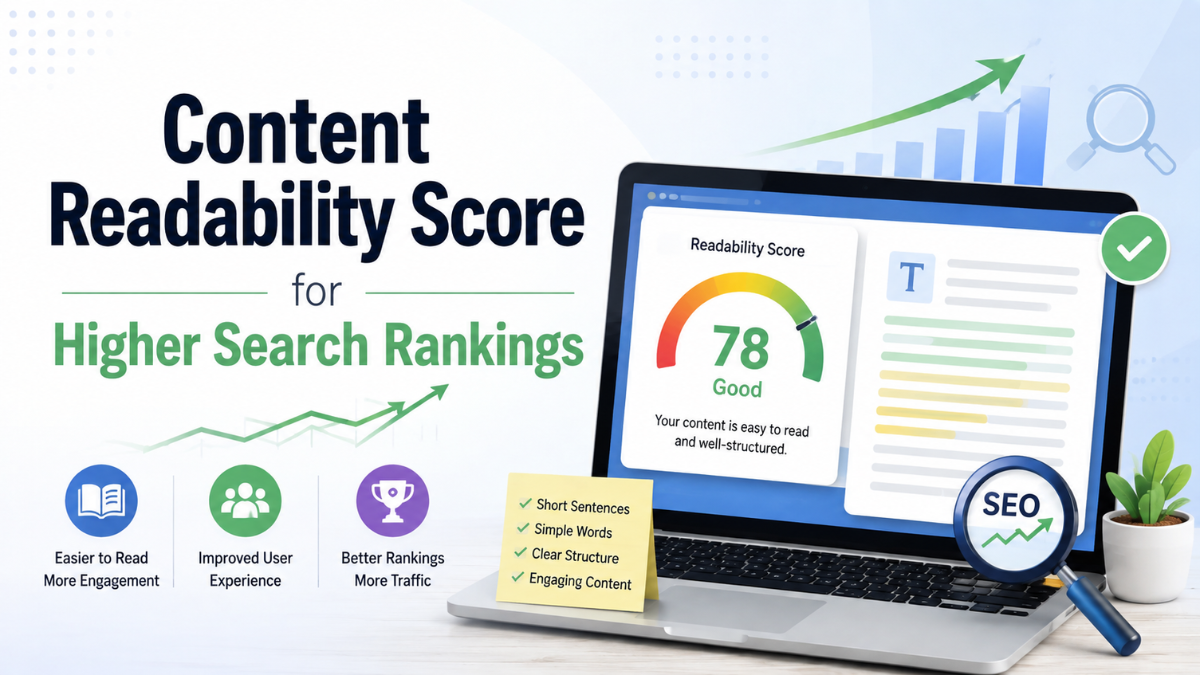
Writing quality content is only one part of successful SEO. Your content must also be easy to read, understand, and navigate. This is where the Content Readability Score becomes important.
Readability also contributes to the overall quality of your content. When evaluating content through E-E-A-T principles—Experience, Expertise, Authoritativeness, and Trustworthiness—clarity and readability help readers understand your expertise and the information you provide.
Search engines aim to provide users with helpful content that answers questions quickly and clearly. If readers struggle to understand your text, they are more likely to leave your website, increasing bounce rates and reducing engagement.
A good Content Readability Score helps visitors stay longer, read more pages, and take action. It also supports better accessibility, improves user experience, and increases the chances of performing better in search results.
Whether you publish blog posts, product pages, landing pages, or guides, readability plays a major role in content performance. By using shorter paragraphs, simple language, descriptive headings, transition words, and logical formatting, you can create content that both users and search engines appreciate.
This guide explains everything you need to know about improving your Content Readability Score while also showing how CrawlHunt can help you evaluate the broader E-E-A-T quality of your content.
What is Content Readability Score?
A Content Readability Score is a measurement that evaluates how easy your content is to read and understand. It considers sentence length, paragraph structure, word complexity, grammar, passive voice, transition words, and overall organization.
Readability tools calculate a score using established formulas, including:
- Flesch Reading Ease
- Flesch-Kincaid Grade Level
- Gunning Fog Index
- SMOG Index
- Coleman-Liau Index
These formulas estimate the education level needed to understand your content. Although each formula is different, they all aim to measure reading difficulty.
A higher readability score generally means your content is easier for a wider audience to understand.
Readability does not replace E-E-A-T evaluation, but it can support content quality by making expertise and helpful information easier for readers to understand.
Factors That Affect Content Readability Score
Many writing elements influence readability.
Sentence Length
Long sentences increase reading difficulty. Keep most sentences between 15 and 20 words.
Paragraph Length
Large blocks of text discourage readers. Limit paragraphs to two or three sentences whenever possible.
Word Choice
Use common words instead of technical jargon unless your audience requires specialized terminology.
For example:
Instead of:
Utilize comprehensive methodologies.
Write:
Use effective methods.
Passive Voice
Active voice improves clarity.
Passive:
The article was written by our team.
Active:
Our team wrote the article.
Heading Structure
Clear headings help readers scan content quickly.
Use:
- H2
- H3
- H4
to organize information logically.
Transition Words
Words such as:
- However
- Therefore
- Additionally
- Next
- Finally
- Meanwhile
- For example
improve content flow.
Lists
Bullet points simplify complex information.
Instead of long paragraphs, organize information into:
- Numbered lists
- Bullet points
- Tables
Formatting
Use:
- Bold text
- Whitespace
- Headings
- Images
- Tables
to improve visual readability.
Reading Level
For most websites, aim for content understandable by students between Grade 7 and Grade 9.
Why Readability Matters for Different Types of Websites
Readability is important across every industry.
Website Type | Why Readability Matters |
|---|---|
Blogs | Keeps readers engaged |
Ecommerce | Improves product understanding |
SaaS | Explains complex software clearly |
Healthcare | Makes medical topics easier |
Finance | Simplifies technical concepts |
Education | Helps students learn faster |
News | Delivers information quickly |
Local Business | Encourages customer inquiries |
Content Readability and E-E-A-T
Readability is one element that can support stronger content quality.
E-E-A-T stands for:
- Experience
- Expertise
- Authoritativeness
- Trustworthiness
A page may contain useful information, expert insights, references, and strong author credentials, but readers still need to understand that information easily.
A strong Content Readability Score can therefore support your E-E-A-T efforts by making important information clearer, easier to scan, and more accessible.
Readable content can help visitors:
- Understand your expertise faster
- Identify important information easily
- Follow your explanations
- Evaluate supporting evidence
- Find sources and references
- Understand the author's experience
- Navigate different sections of the article
However, readability is only one part of content quality. Author information, reliable citations, first-hand experience, source credibility, factual accuracy, and transparency also contribute to stronger E-E-A-T. A thorough SEO audit that checks these elements alongside a technical SEO audit gives a much fuller picture of content quality than readability checks alone.
Check Your E-E-A-T Score with CrawlHunt
Instead of reviewing readability and content credibility manually, you can use CrawlHunt's E-E-A-T Analysis inside the Blog SEO Manager.
The tool analyzes your content across important E-E-A-T factors and provides an overall E-E-A-T Score along with recommendations for improving your article.
CrawlHunt reviews areas related to:
- Experience
- Expertise
- Authoritativeness
- Trustworthiness
- Content clarity
- Supporting sources
- Author credibility
- Content structure
- Readability-related improvements
You can add or review the E-E-A-T Analysis block, analyze your article, and check your E-E-A-T Score before publishing.
How to Check Your Content E-E-A-T Score
CrawlHunt Website SEO Audit Tool
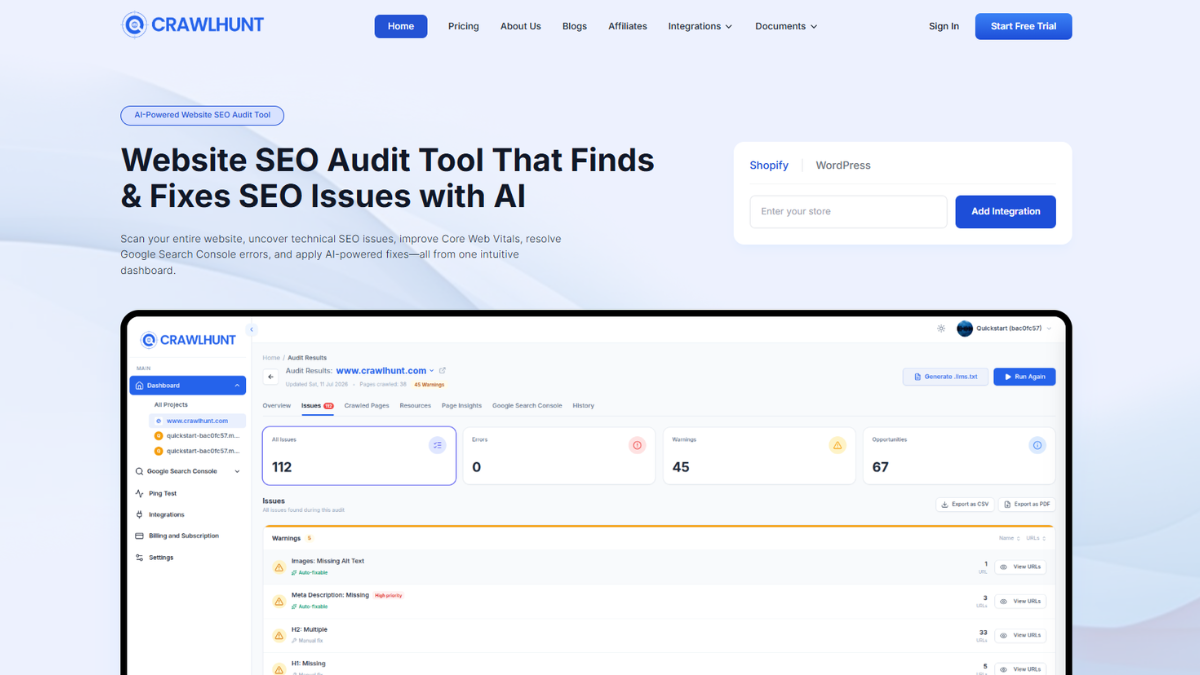
Creating valuable content is only part of a successful SEO strategy. You also need to establish experience, expertise, authoritativeness, and trustworthiness to help readers and search engines understand the quality of your content.
CrawlHunt's Blog SEO Manager includes an E-E-A-T Analysis tool that evaluates your article and provides actionable suggestions to improve its credibility.
Follow this step-by-step guide to check your E-E-A-T Score and optimize your Shopify blog content before publishing.
Step 1: Open the E-E-A-T Analysis Tool
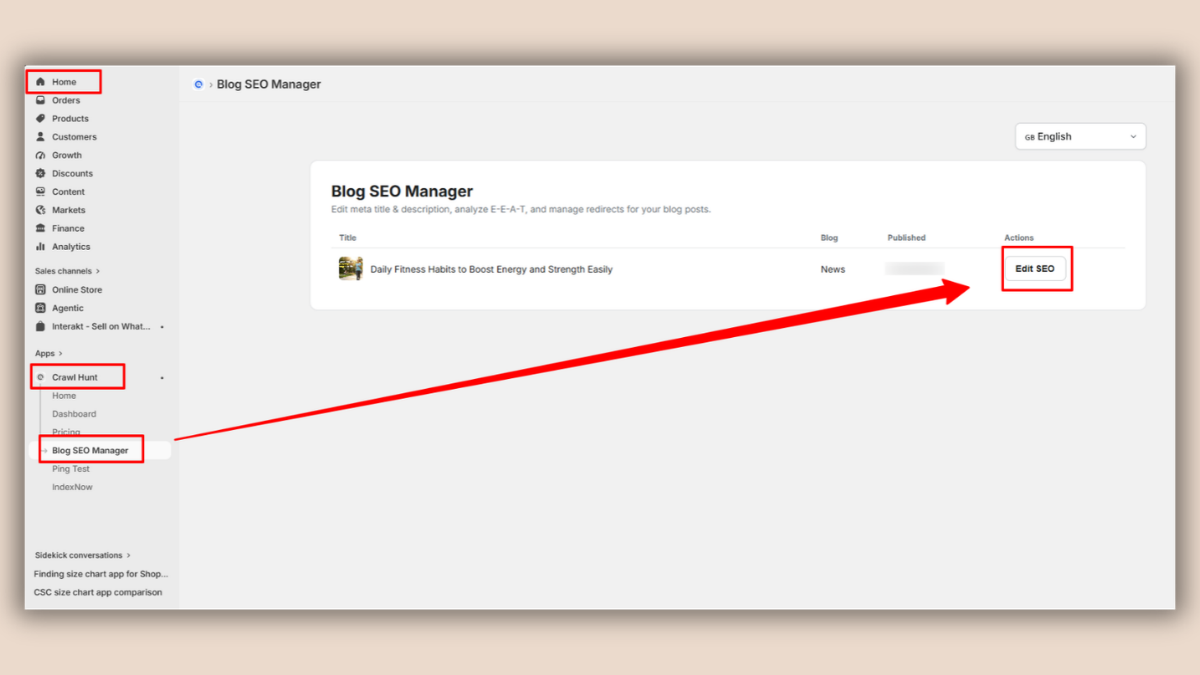
The first step is to open your Shopify admin dashboard and navigate to CrawlHunt's Blog SEO Manager. Select an existing blog post or create a new article in the editor.
On the right side of the content editor, you will find the E-E-A-T Analysis panel.
This tool evaluates your article based on four key factors:
- Experience
- Expertise
- Authoritativeness
- Trustworthiness
Open the analysis panel to review your article's overall score and identify areas that may need improvement.
Step 2: Review Your E-E-A-T Score
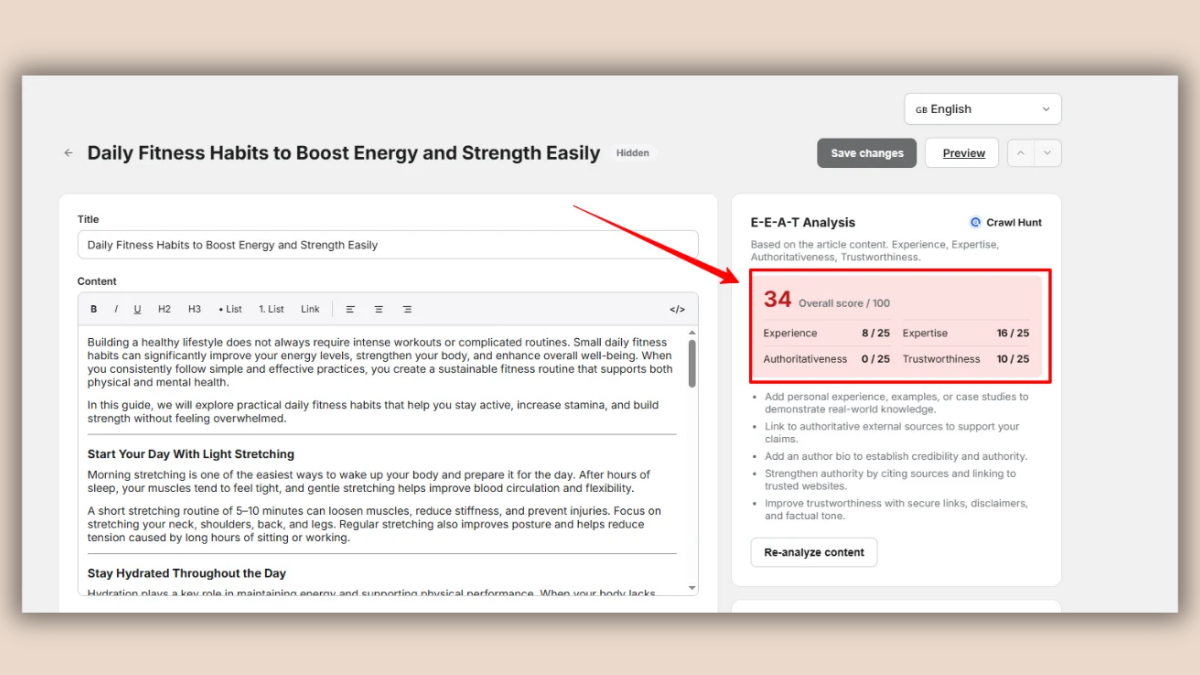
Once the analysis is available, review the overall E-E-A-T Score displayed in the CrawlHunt dashboard.
The example report shows an overall score of 78 out of 100, with individual scores for each E-E-A-T factor.
Review each score to understand which areas of your content perform well and where you can make improvements.
A lower score in one category can help you identify opportunities to strengthen your article's credibility and usefulness.
Step 3: Improve Your Content Using AI-Powered Suggestions
After reviewing your E-E-A-T Score, check the recommendations provided by CrawlHunt.
The analysis may highlight suggestions such as:
- Adding an author bio
- Establishing author credibility
- Adding reliable citations
- Linking to trusted websites
- Improving content clarity
- Strengthening supporting information
Use these recommendations to improve your article before publishing.
You can also re-analyze the content after making changes to review the updated results.
CrawlHunt's Blog SEO Manager also helps you optimize important SEO elements through AI-powered tools, including:
AI Meta Title and Description Generation: Create relevant meta titles and descriptions based on your blog content to improve search-result presentation.
Custom URL Redirects: Manage changed or outdated URLs to prevent broken links and help visitors reach the correct pages.
Blog SEO Management: Review and optimize your blog content within the Shopify dashboard.
Remember that an E-E-A-T score is a content quality indicator, not a direct Google ranking factor. Use it alongside accurate information, relevant sources, clear authorship, helpful content, and a strong Content Readability Score to strengthen your SEO strategy.
Step 4: Review Long Sentences
Long sentences often reduce readability and make information harder to understand. Most readability tools highlight sentences that exceed the recommended length.
Go through every highlighted sentence and divide it into two or three shorter sentences where possible.
Remove unnecessary words, simplify explanations, and keep each sentence focused on a single idea.
For example:
Before
Although search engines continue evolving rapidly, businesses that consistently publish highly optimized content using advanced optimization strategies while maintaining keyword relevance often achieve stronger rankings over time.
After
Search engines continue to evolve. Businesses that publish optimized content consistently often achieve stronger rankings. Keeping content clear and relevant improves long-term SEO performance.
Shorter sentences improve clarity without removing important information.
Step 5: Simplify Complex Words
Many readability tools identify difficult words that may confuse readers. Replace technical jargon with simpler alternatives whenever possible.
Complex Word | Simple Alternative |
|---|---|
Utilize | Use |
Commence | Start |
Facilitate | Help |
Demonstrate | Show |
Approximately | About |
Numerous | Many |
Subsequently | Later |
Simple language improves accessibility while keeping your message professional.
Step 6: Check Paragraph Length
Large paragraphs can overwhelm readers, especially on mobile devices.
Most readability tools recommend keeping paragraphs short and visually appealing.
Review each paragraph and separate lengthy sections into smaller blocks. Aim for two or three sentences per paragraph whenever possible.
Adding white space makes your article easier to scan and encourages readers to continue scrolling.
Step 7: Analyze Passive Voice
Passive voice often makes sentences sound indirect and less engaging.
Readability tools usually identify passive constructions and suggest active alternatives.
Passive
The report was completed by the marketing team.
Active
The marketing team completed the report.
Active voice improves clarity and creates a stronger connection with readers.
Step 8: Improve Heading Structure
Headings help organize information and allow visitors to scan your content quickly.
During your readability review, check whether your headings follow a logical order.
A well-structured article should include:
- One H1 title
- Multiple H2 sections
- Supporting H3 headings
- Additional H4 headings only when necessary
Descriptive headings improve both user experience and SEO by making content easier to navigate.
Step 9: Add Transition Words
Transition words connect ideas smoothly and improve reading flow.
Many readability tools measure how often transition words appear throughout your article.
Examples include:
- Additionally
- Furthermore
- However
- Therefore
- Next
- Meanwhile
- For example
- Finally
- In contrast
- As a result
Use these naturally to guide readers through your content without making it feel repetitive.
Step 10: Review the Overall Readability Report
After making improvements, run another readability analysis.
Compare the updated report with the previous version and verify that your score has improved.
Check whether the following areas have been enhanced:
- Shorter sentences
- Smaller paragraphs
- Better formatting
- Improved transitions
- Lower passive voice
- Easier vocabulary
- Clear heading hierarchy
Repeat the editing process until your content becomes easier to read while maintaining accuracy and SEO.
A comprehensive On Page SEO Audit Report can also identify readability issues, heading structure problems, and content formatting errors that affect both users and search engine visibility.
Once your readability improvements are complete, reviewing the article again with CrawlHunt's E-E-A-T Analysis can help identify additional credibility, authority, trust, or experience signals that may still need improvement.
Advanced Tips to Improve Your Content Readability Score
Once you've mastered the basics, you can use advanced writing and SEO techniques to make your content even more engaging.
These strategies improve readability while helping users find answers quickly and encouraging them to stay on your website longer.
Match Search Intent Before You Write
Every piece of content should satisfy a specific user intent.
Before writing, identify what readers are looking for when they search for your target keyword.
Along with readability, keyword density analysis helps ensure your primary keywords appear naturally throughout the content without leading to keyword stuffing.
For example:
Search Intent | Content Type |
|---|---|
Informational | Guides, tutorials, blogs |
Commercial | Comparisons, reviews |
Transactional | Product pages |
Navigational | Brand or service pages |
When your content directly answers user questions, visitors are more likely to remain on the page and continue reading.
Answer Important Questions Early
Many users skim articles before deciding whether to continue reading.
Place the most valuable information near the beginning of each section instead of hiding it deep within long paragraphs.
A simple structure works well:
- Answer the question.
- Explain why it matters.
- Give an example.
- Offer actionable advice.
This format keeps readers engaged and improves content clarity.
Write in a Conversational Tone
Avoid writing as if you're creating an academic paper.
Instead, use natural language that sounds like you're explaining a topic to another person.
For example:
Less Readable
"The implementation of readability optimization methodologies facilitates enhanced comprehension."
More Readable
"Improving readability helps people understand your content faster."
A conversational style increases engagement without sacrificing professionalism.
Maintain Consistent Formatting
Consistency makes articles easier to scan.
Follow these formatting practices:
- Keep heading styles uniform.
- Use similar paragraph lengths.
- Format lists consistently.
- Use tables only when comparing information.
- Highlight important terms with bold text.
- Leave enough white space between sections.
Readers can process information more quickly when the layout remains predictable.
Optimize for Featured Snippets
Google often selects well-structured content for featured snippets.
To improve your chances:
- Answer questions in the first paragraph.
- Use numbered steps.
- Add concise definitions.
- Create comparison tables.
- Include FAQ sections.
- Use descriptive headings.
Well-organized content benefits both readers and search engines.
Although readability focuses on user experience, implementing schema markup for SEO helps search engines better understand your content and may improve your visibility in rich search results.
Use Internal Links Naturally
Internal links guide visitors toward related content and improve website navigation.
For example, if you're discussing on-page SEO, you can link to articles about:
- Keyword research
- Meta descriptions
- Technical SEO
- Website speed, including factors like largest contentful paint
- Core Web Vitals
Internal linking also helps search engines discover and understand your content structure. Following a clear internal linking strategy and fixing issues such as broken links or crawl errors keeps your site easy for both visitors and search engines to navigate.
Using relevant Internal and External Links strengthens content credibility, improves navigation, and helps readers discover additional valuable resources.
External citations from reliable sources may also strengthen the trustworthiness and authority signals evaluated during an E-E-A-T review.
Keep Updating Older Content
Content freshness contributes to long-term SEO success.
Review older articles regularly to:
- Update outdated statistics.
- Replace broken links.
- Improve formatting.
- Add new examples.
- Expand thin sections.
- Refresh screenshots.
It's also worth checking older pages for issues like thin or repeated content — running a quick check to fix duplicate content helps protect the rankings you've already built while you refresh the page.
Regular updates help maintain relevance and improve user trust.
After updating older content, you can run CrawlHunt's E-E-A-T Analysis again to check whether your improvements have strengthened the overall quality of the article.
Best Tools to Measure Readability
Several tools can evaluate your writing and provide suggestions for improvement.
Tool | Best For | Key Features |
|---|---|---|
Hemingway Editor | Sentence clarity | Highlights complex sentences, passive voice, and difficult words |
Grammarly | Grammar and readability | Grammar correction, tone suggestions, clarity improvements |
Yoast SEO | WordPress readability | Readability analysis, transition words, passive voice detection |
Rank Math | SEO optimization | Readability insights alongside SEO recommendations |
Microsoft Word | Basic analysis | Reading statistics and grammar checking |
Google Docs Add-ons | Writing assistance | Readability and grammar support |
ProWritingAid | Professional editing | Style improvements and readability reports |
Using more than one tool can provide a broader view of your writing quality.
For Shopify content, you can additionally use CrawlHunt's E-E-A-T Analysis to evaluate broader content-quality signals beyond basic readability.
Readability Score Benchmarks
Different readability formulas use different scales.
The following table provides general guidance:
Readability Metric | Ideal Range | Meaning |
|---|---|---|
Flesch Reading Ease | 60–80 | Easy for most readers |
Flesch-Kincaid Grade | Grade 7–9 | Suitable for general audiences |
Gunning Fog Index | Below 12 | Easy to understand |
SMOG Index | 7–10 | Appropriate for most websites |
Passive Voice | Below 10% | Clearer writing |
Average Sentence Length | 15–20 words | Better readability |
Paragraph Length | 2–3 sentences | Easier scanning |
These are guidelines rather than strict rules. The ideal score depends on your audience and topic.
Your Content Readability Score should therefore be treated as one part of a broader content-quality review rather than a standalone SEO metric.
Combine Readability with E-E-A-T Analysis
Improving readability makes your content easier to understand, but strong content should also demonstrate credibility and trust.
Before publishing an important article, review both areas.
First, check whether the content is easy to read:
- Are sentences concise?
- Are paragraphs short?
- Are headings descriptive?
- Is the language understandable?
- Can users scan the content easily?
Then review your E-E-A-T signals:
- Does the article demonstrate experience?
- Is the author clearly identified?
- Does the content demonstrate expertise?
- Are reliable sources included?
- Are factual claims supported?
- Does the page provide trustworthy information?
CrawlHunt's E-E-A-T Analysis can help bring these checks together by analyzing your content and providing suggestions before publication.
Add the E-E-A-T Block and Check Your Score
Open CrawlHunt's Blog SEO Manager, select your article, and use the E-E-A-T Analysis block to review your content.
Check the overall score, inspect the individual Experience, Expertise, Authoritativeness, and Trustworthiness results, and apply the recommended improvements.
After updating your content, run the analysis again to see how your score changes.
Watch the walkthroughs here:
Introducing CrawlHunt Blog SEO Manager
How to Add CrawlHunt E-E-A-T Redirect Meta Title Description Blocks Single Product Page Dashboard
This allows you to review more than readability alone and gives you a broader understanding of your article's overall content quality.
Conclusion
A strong Content Readability Score helps create content that is easy to understand, engaging, and valuable for readers.
While search engines focus on many ranking factors, readability supports important SEO outcomes such as stronger engagement, easier content consumption, and improved user experience.
Readability can also support your broader E-E-A-T strategy by making experience, expertise, authoritative information, citations, and trustworthy content easier for visitors to understand.
By using shorter sentences, clear headings, simple language, structured formatting, and logical content organization, you can improve both user experience and search visibility.
Regularly reviewing your articles with readability tools and updating older content ensures your website continues to meet modern SEO standards.
You can also use CrawlHunt's E-E-A-T Analysis to review Experience, Expertise, Authoritativeness, and Trustworthiness alongside your readability improvements.
Combining readability improvements with E-E-A-T analysis, technical SEO practices, and tools like CrawlHunt creates a solid foundation for long-term organic growth and higher-quality content.
Frequently Asked Questions (FAQs)
What is a good Content Readability Score?
A good score depends on the formula being used. For most websites, aiming for a Flesch Reading Ease score between 60 and 80 or a Grade 7–9 reading level makes content accessible to a broad audience.
Does readability affect SEO rankings?
Readability is not a direct ranking factor. However, easy-to-read content can improve user experience, engagement, and overall content quality, which supports a stronger SEO strategy.
Is readability part of E-E-A-T?
Readability is not one of the four E-E-A-T components itself. However, clear and understandable content can support E-E-A-T by making expertise, experience, supporting evidence, and trustworthy information easier for readers to understand.
How can I check my content's E-E-A-T Score?
You can use CrawlHunt's E-E-A-T Analysis inside the Blog SEO Manager. It evaluates your article across Experience, Expertise, Authoritativeness, and Trustworthiness and provides recommendations for improvement.
How often should I check my content's readability?
Check readability before publishing every article. It's also a good practice to review older content periodically, especially after major updates or SEO improvements.
What is the ideal sentence length for readable content?
Most readability experts recommend keeping sentences between 15 and 20 words. Shorter sentences are easier to understand and improve the reading experience.
Can images improve readability?
Yes. Images, tables, infographics, screenshots, and charts break up large blocks of text, explain concepts visually, and make content more engaging for readers.
How can I improve readability without removing important information?
Focus on simplifying language, shortening sentences, using descriptive headings, breaking long paragraphs into smaller sections, and adding bullet points or tables where appropriate. This keeps the information complete while making it easier to understand.