
If you have a website but it is not ranking on Google, the problem is often not backlinks or ads; the problem is on-page SEO. Many beginners focus only on content writing but ignore technical and on-page factors that directly affect search rankings. This is where an on page seo audit report becomes very important. It helps you understand what is working on your website and what needs improvement for better search engine visibility.
An SEO Page audit is like a health checkup for your website. It checks your website structure, content quality, keyword usage, page speed, mobile friendliness, internal linking, meta tags, and many other SEO elements. Without an audit, you are guessing. With an audit report, you are making data-driven SEO decisions.
In this complete beginner's guide, you will learn what an on-page SEO audit is, check seo issues, why it is important, and how to create a complete on page seo audit report step by step.
Why On Page SEO Audit is Important?
Before learning how to create an on page seo audit report, it is important to understand why it matters.
- Improves Search Engine Rankings: On-page SEO helps search engines understand your content. Proper keyword placement, optimized headings, and meta tags improve ranking chances.
- Improves Website User Experience: SEO is not only for search engines but also for users. Fast loading pages, readable content, and a mobile-friendly design improve user experience.
- Increases Organic Traffic: When your pages are properly optimized, they rank higher in search results, which increases organic traffic.
- Finds SEO Errors: An audit report helps identify broken links, missing meta tags, duplicate content, and check SEO issues.
- Helps Content Optimization: An on page seo audit report helps you update old content with new keywords, internal links, and better structure.
Complete On Page SEO Audit Report Process
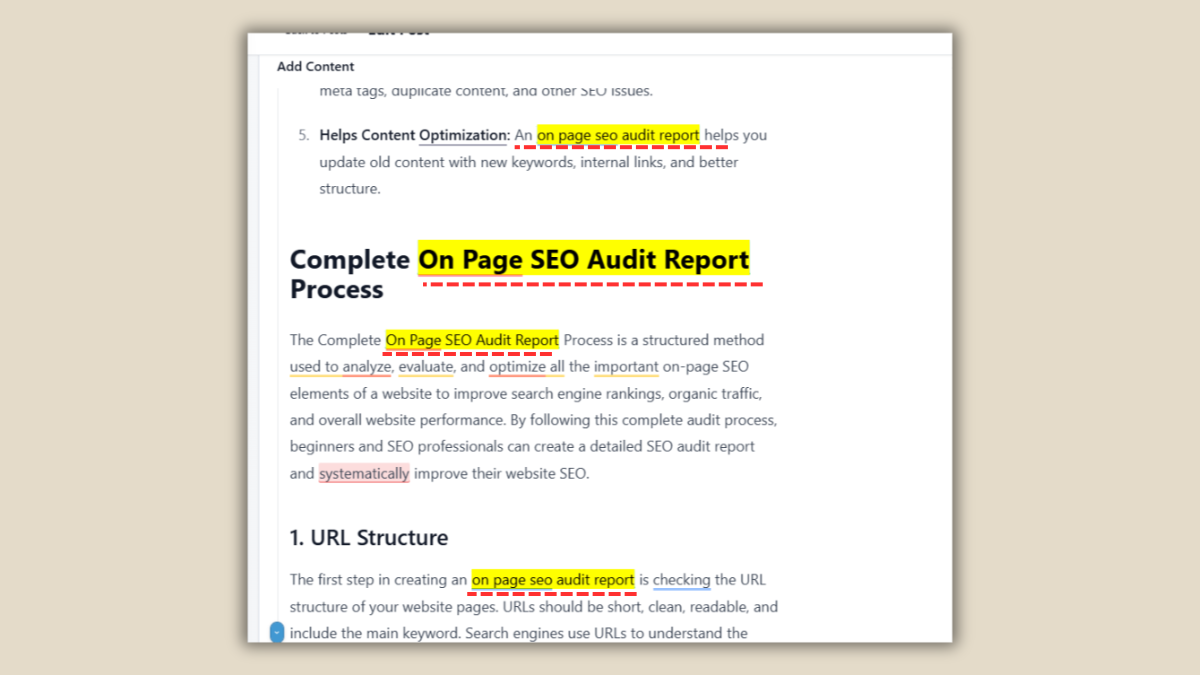
The Complete On Page SEO Audit Report Process is a structured method used to analyze, evaluate, and optimize all the important on-page SEO elements of a website to improve search engine rankings, organic traffic, and overall website performance. While conducting a detailed seo audit, identifying common SEO mistakes to avoid helps ensure your optimization efforts deliver better rankings, improved traffic, and a stronger overall website performance. By following this complete audit process, beginners and SEO professionals can create a detailed SEO audit report and systematically improve their website SEO.
1. URL Structure
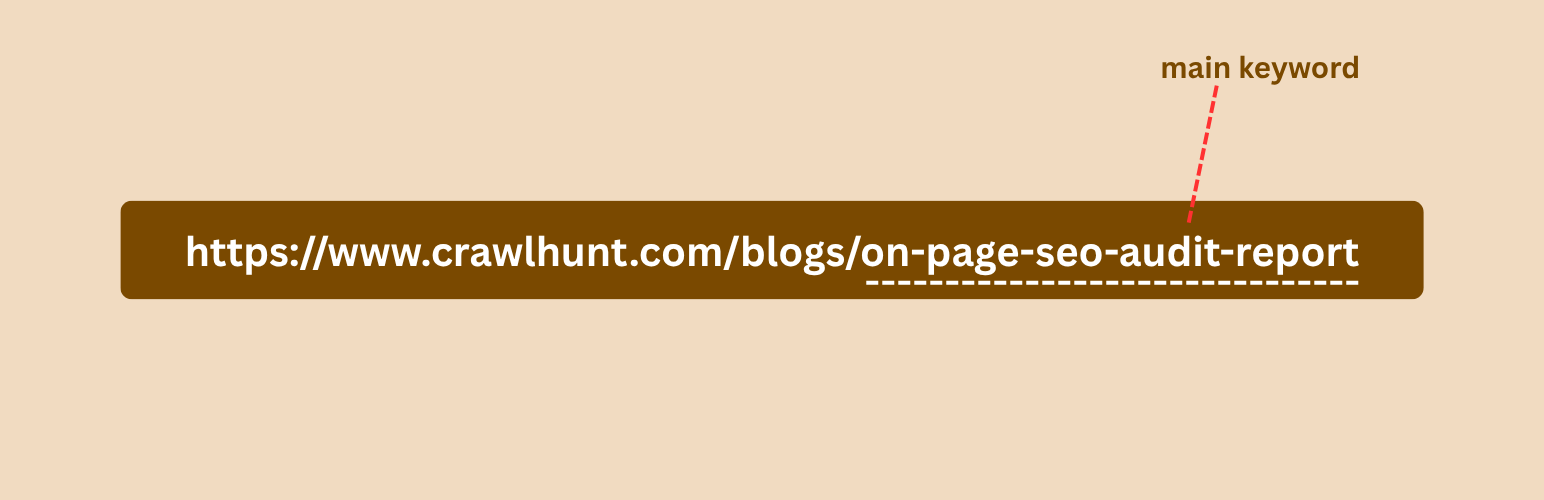
The first step in creating an on page seo audit report is checking the URL structure of your website pages. URLs should be short, clean, readable, and include the main keyword. Search engines use URLs to understand the page topic, so SEO-friendly URLs help improve rankings. A good URL should not contain random numbers, special characters, or long strings. Instead, it should clearly describe the page content so both users and search engines can understand the page before even opening it.
For example, a URL like example.com/on-page-seo-audit-report is much better than example.com/page?id=123. Short and keyword-rich URLs improve user experience and search engine crawling. During the audit, you should check whether URLs are optimized, consistent, and properly structured across the website. If URLs are too long or not keyword optimized, they should be updated for better SEO performance and improved indexing.
Here, Crawlhunt works best for URL structure analysis and optimization. In Crawlhunt, there are two main options to manage and optimize URLs. The first option is Add Title, where you can add the main title of the page, and the site seo audit tool automatically generates an SEO-friendly URL based on the title. The second option allows you to edit the URL manually if you do not like the generated URL or if you want to add a specific keyword. This is useful in different scenarios where you want shorter URLs, keyword-focused URLs, or category-based URLs. Using these options, you can easily create SEO-friendly URLs and improve your website structure, which is an important part of an on page seo audit report.
CrawlHunt Pricing: Choose the CrawlHunt plan that matches your SEO goals. The Basic plan is offered free for life, the Growth plan costs $59/month, and the Scale plan is priced at $149/month for businesses requiring expanded SEO resources.
2. Title Tag Optimization
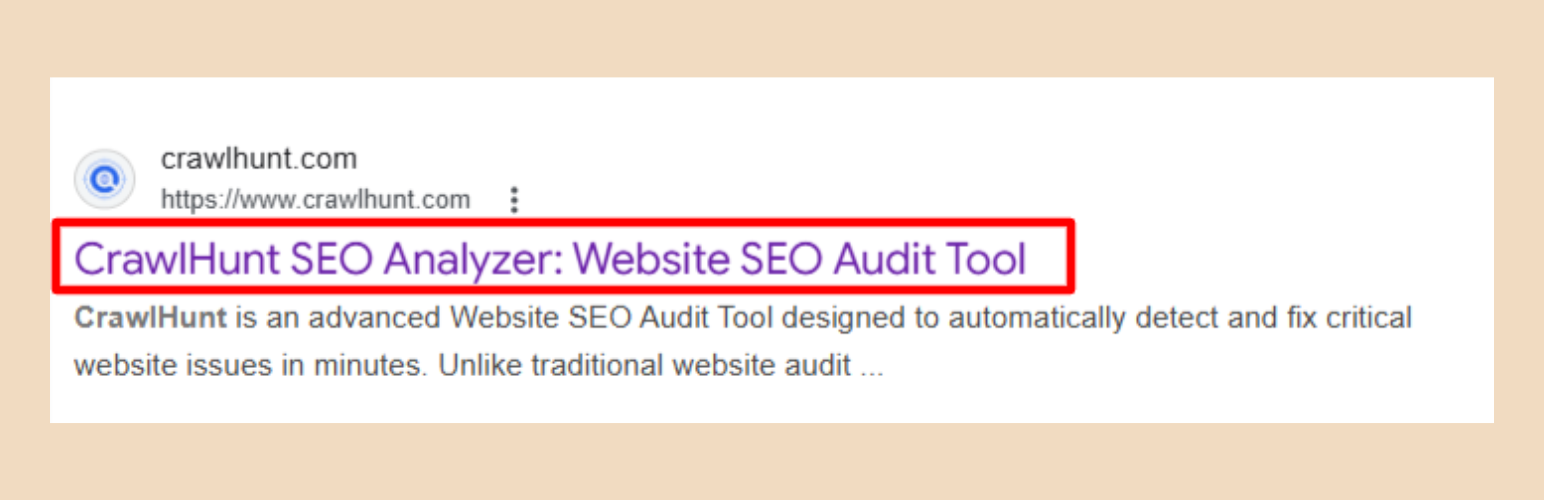
The title tag is the main clickable headline that appears in search engine results, and it helps both users and search engines understand what your page is about. It is one of the most important ranking factors, which is why it must be included in every on page seo audit report. A well-optimized title tag improves visibility, increases click-through rate (CTR), and helps your page rank higher on Google.
In Crawlhunt, which is one of the best SEO crawling tools, you have to add a title in the Add Title section at the beginning, where you can write and optimize your page title easily. A good title tag should be 50–60 characters long, include the primary keyword, and clearly describe the content. During the audit, you should check whether each page has a unique and keyword-optimized title. If the title is missing, duplicated, or too long, it should be corrected immediately for better SEO performance.
3. Meta Description Optimization
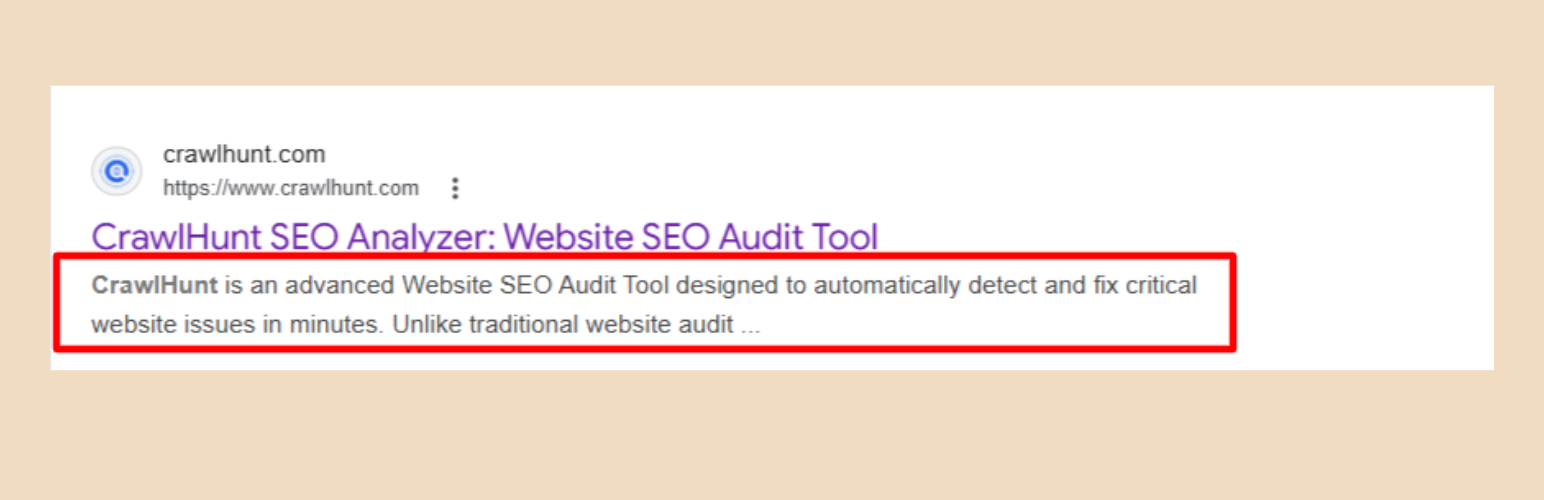
Meta description is a short summary of a webpage that appears below the title tag in search engine results. It helps users understand what the page is about before they click on it. Even though meta descriptions are not a direct ranking factor, they are very important because they improve click-through rate (CTR), which indirectly helps improve SEO performance. A clear and attractive meta description can bring more visitors to your website from search engines.
In Crawlhunt, you can add the meta description in the Meta Description field, where you should write a short summary of the page content with the main keyword. The ideal meta description length should be between 150–160 characters so that it displays properly in search results. During an on page seo audit report, you should check whether each page has a meta description, whether the keyword is included, and whether it is unique for every page.
The meta description should clearly explain the page and include action words like “Learn,” “Read,” “Discover,” or “Find.” Missing meta descriptions should be added, and duplicate meta descriptions should be rewritten for better SEO results.
4. Header Tags Optimization (H1, H2, H3)
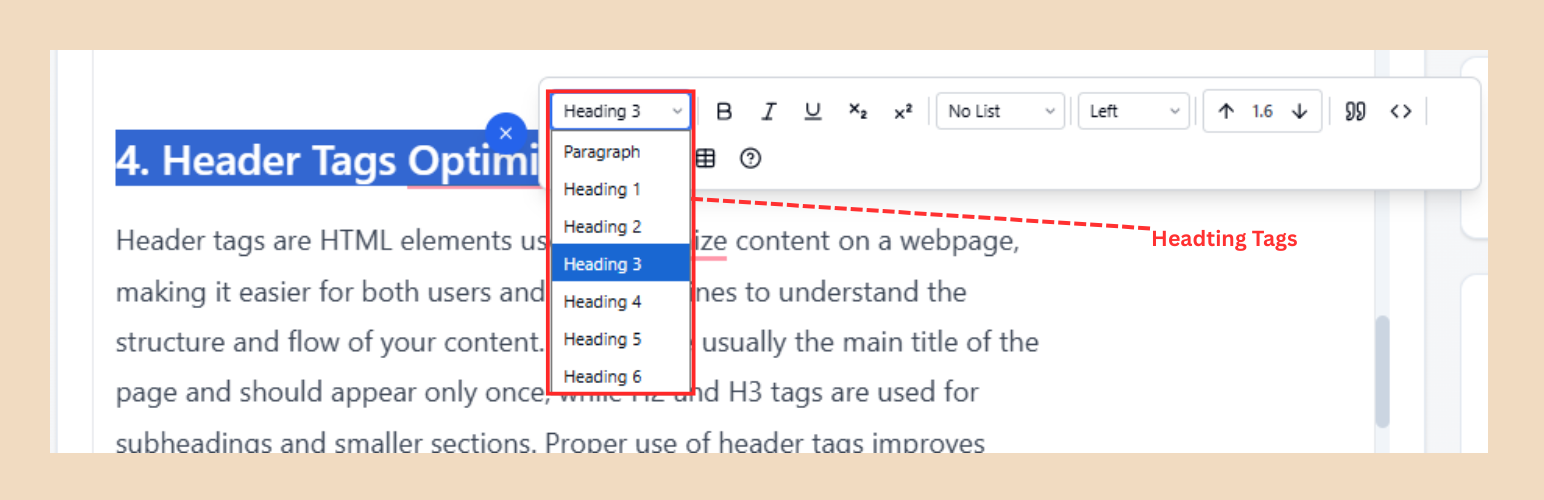
Header tags are HTML elements used to organize content on a webpage, making it easier for both users and search engines to understand the structure and flow of your content. H1 tags are usually the main title of the page and should appear only once, while H2 and H3 tags are used for subheadings and smaller sections. Proper use of header tags improves readability, user experience, and SEO performance. Pages without structured headings can appear cluttered and are harder for search engines to crawl effectively.
When preparing an on page seo audit report, you should check whether each page has a proper heading structure, whether the H1 tag includes the main keyword, and whether H2 and H3 tags are used appropriately to break content into sections. You can use Crawlhunt to verify your header tags. Simply paste your content, and this Best SEO Audit Tool will highlight whether your tags are accurate, missing, or improperly used. Correcting header tag issues ensures better SEO rankings and a more organized, user-friendly page.
5. Keyword Optimization Audit
Keyword optimization is the heart of on-page SEO and a critical part of every on page seo audit report. It ensures that your content is targeting the right keywords that your audience is searching for, helping search engines understand the relevance of your page. Proper keyword placement allows your page to rank higher and attract the right traffic. The main keyword should appear naturally in key areas such as the title tag, meta description, H1 tag, first paragraph, URL, and image alt text.
In addition to the main keyword, you should also include related keywords and LSI (Latent Semantic Indexing) keywords, which are semantically related terms that help search engines better understand the topic of your page. It’s equally important to check keyword density to avoid keyword stuffing, which can negatively impact SEO. SEO analysis tools like Crawlhunt make this process easy, as you can analyze your content directly, check keyword placement, density, and LSI usage, and get suggestions for optimization. Using these insights ensures that your content is fully optimized for both search engines and users.
6. Content Quality Audit
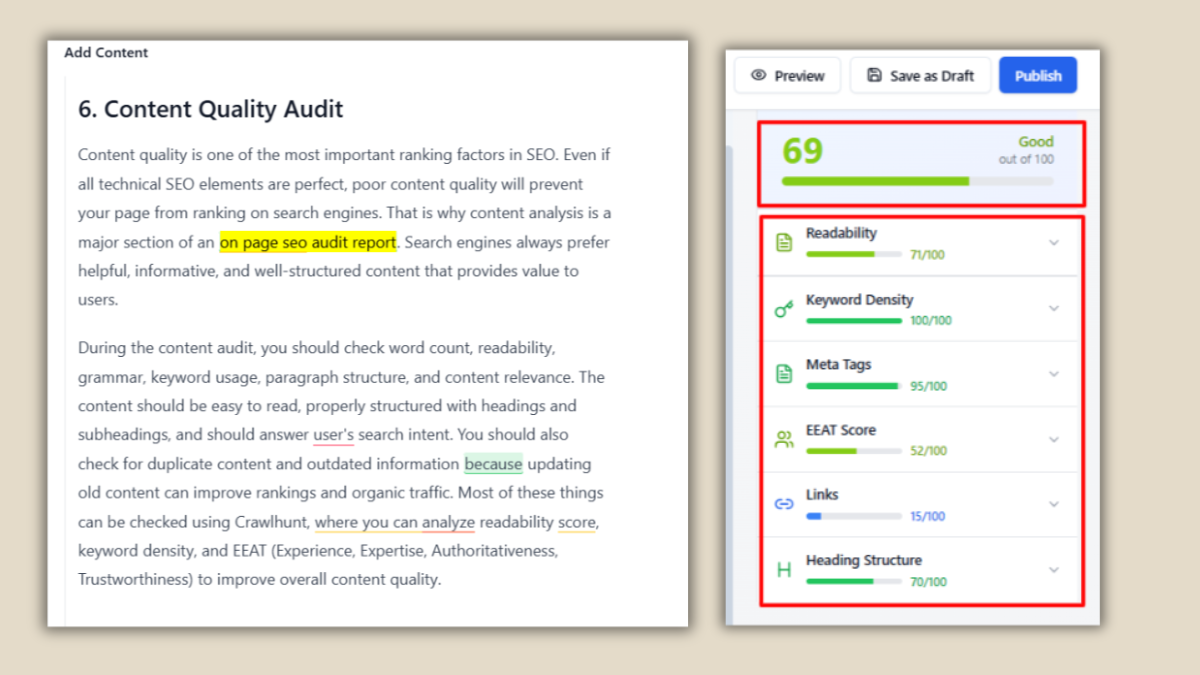
Content quality is one of the most important ranking factors in SEO. Even if all technical SEO elements are perfect, poor content quality will prevent your page from ranking on search engines. That is why content analysis is a major section of an on page seo audit report. Search engines always prefer helpful, informative, and well-structured content that provides value to users.
During the content audit, you should check word count, readability, grammar, keyword usage, paragraph structure, and content relevance. The content should be easy to read, properly structured with headings and subheadings, and should answer the user's search intent. You should also check for duplicate content and outdated information because updating old content can improve rankings and organic traffic. Most of these things can be checked using Crawlhunt, where you can analyze readability score, keyword density, and EEAT (Experience, Expertise, Authoritativeness, Trustworthiness) to improve overall content quality.
7. Internal Linking Audit
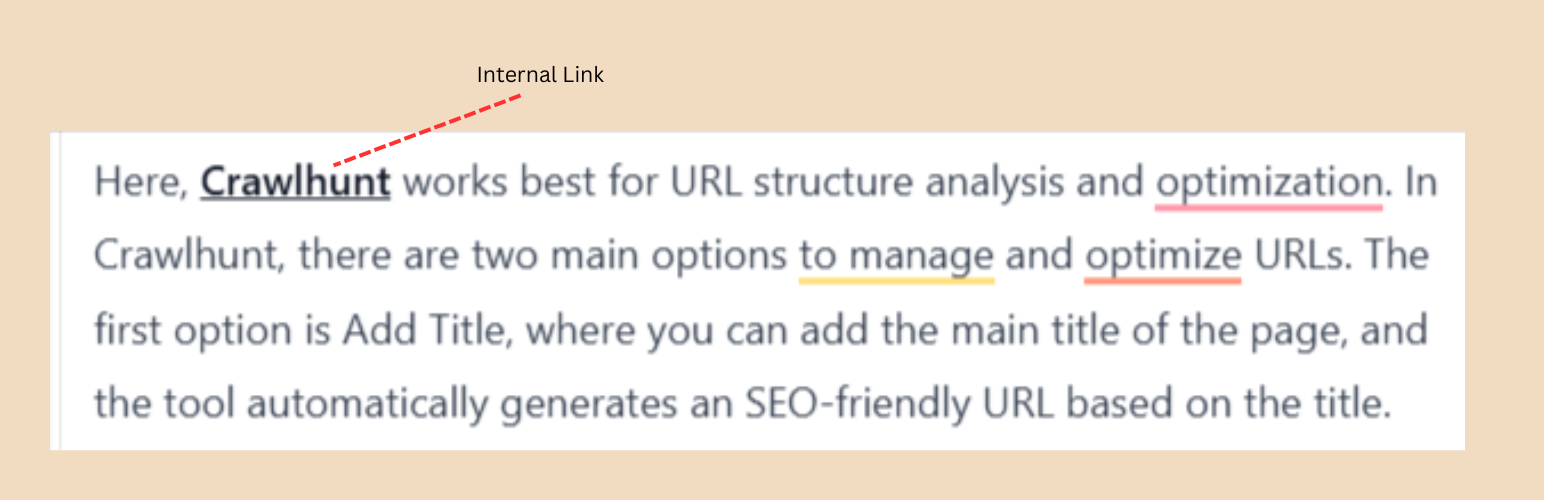
Internal linking means linking one page of your website to another page on the same website. Internal links help search engines crawl your website and understand your website structure properly. They also help distribute page authority across pages and make navigation easier for users, which improves user experience and SEO performance.
In an on page seo audit report, you should check whether pages have enough internal links, whether the anchor text is relevant to the linked page, and whether there are any broken internal links. Important pages should have more internal links pointing to them so that search engines consider them important pages. Proper internal linking improves SEO, reduces bounce rate, increases page views, and keeps users on the website longer.
8. Image Optimization Audit
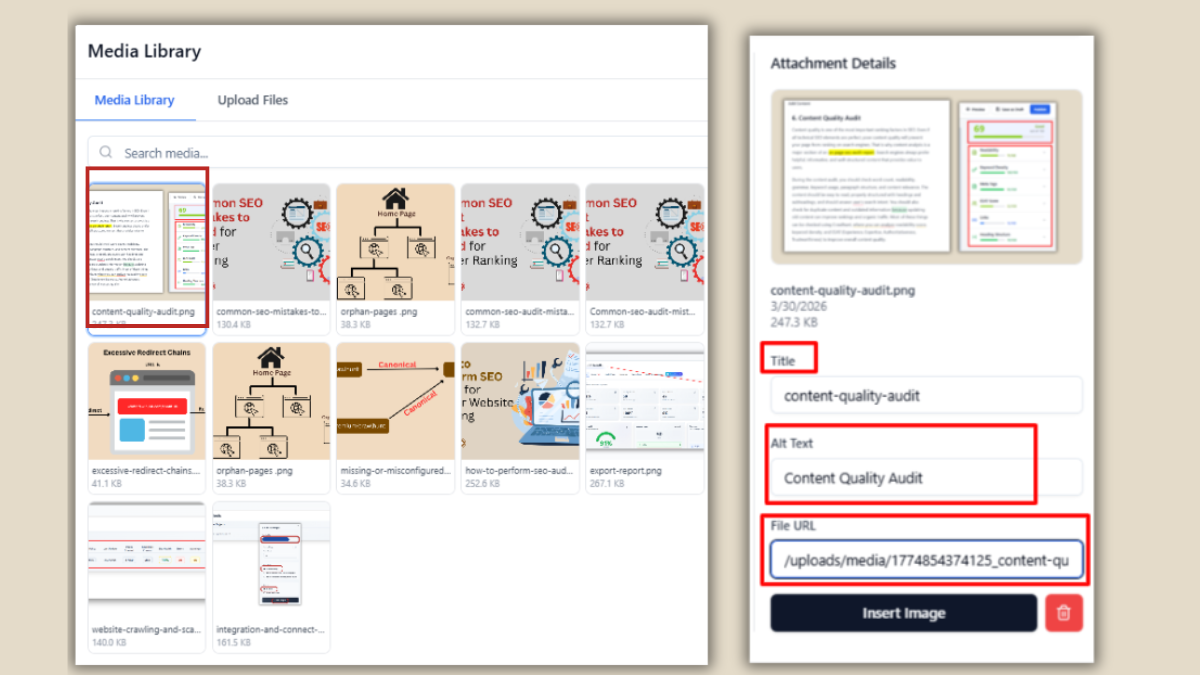
Images are an important part of website content, but they must be optimized for SEO and page speed. Large and uncompressed images can slow down the website, which negatively affects SEO rankings and user experience. That is why image optimization must be included in an on page seo audit report.
During the image audit, you should check whether images have alt text, whether the alt text includes keywords, whether images are compressed, and whether proper file names are used. File names should be descriptive and keyword-related instead of random names like image1.jpg. Using modern image formats like WebP and enabling lazy loading can improve page speed. Properly optimized images help improve SEO, page speed, and accessibility. You can do all the things
9. Page Speed Audit
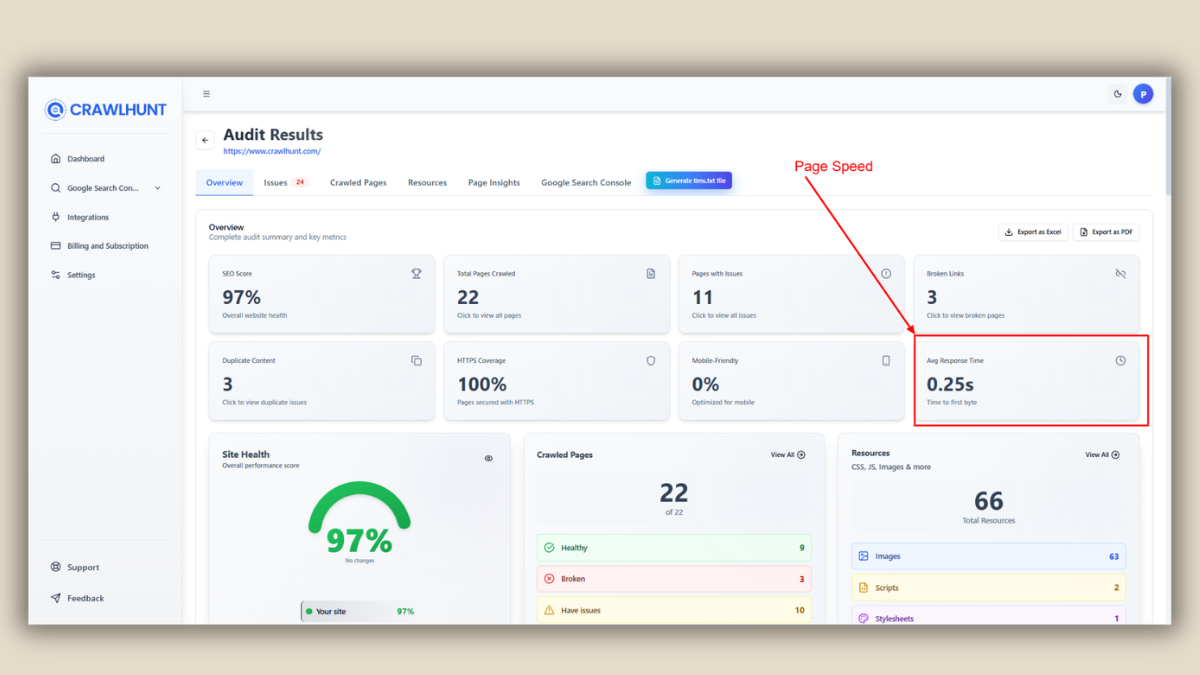
Page speed is a confirmed Google ranking factor, so it is a very important part of an on page seo audit report. If a website loads slowly, users usually leave the website quickly, which increases bounce rate and reduces rankings. A fast-loading website improves user experience and helps improve search engine rankings.
You should test page speed using tools like Google PageSpeed Insights or GTmetrix. During the audit, you should check what is slowing down the website, such as large images, unoptimized CSS and JavaScript files, slow server response time, too many plugins, or no caching enabled. Improving page speed by compressing images, enabling caching, using a CDN, and optimizing code can significantly improve SEO performance and user experience.
10. Mobile Friendliness Audit
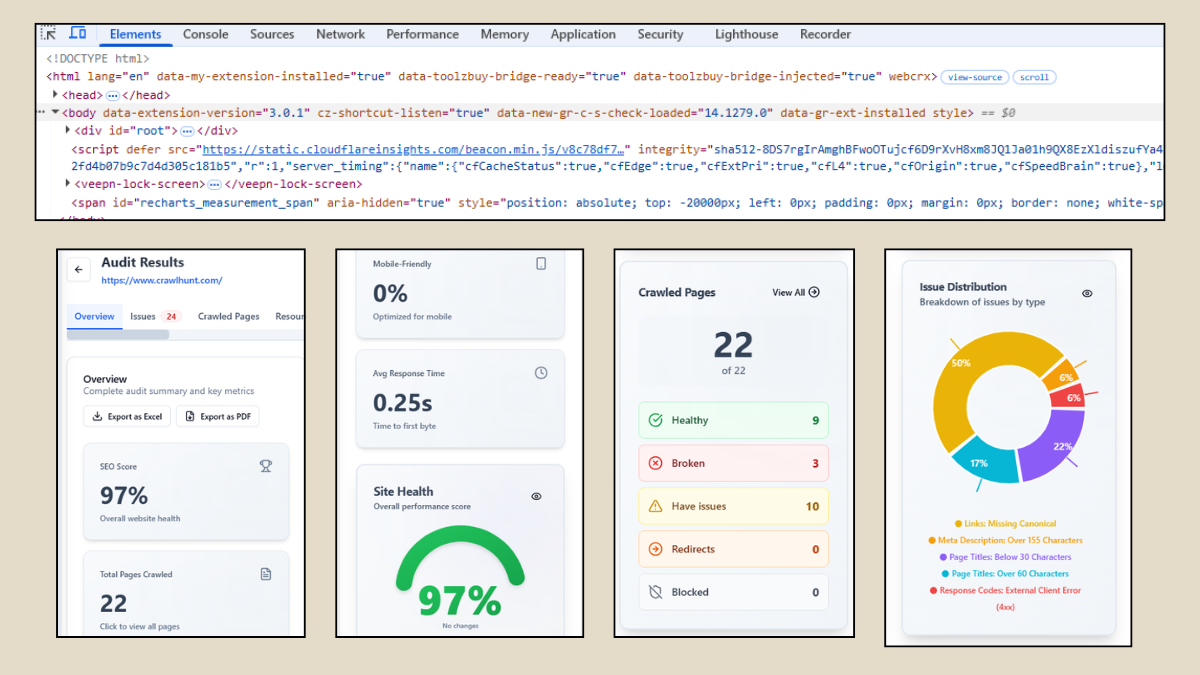
Most users now browse websites on mobile devices, and Google uses mobile-first indexing. This means Google mainly uses the mobile version of a website for ranking and indexing. If your website is not mobile-friendly, it may not rank well in search results even if the desktop version is perfect.
In the on page seo audit report, you should check whether the website is responsive, whether text is readable without zooming, whether buttons are properly clickable, and whether the website loads fast on mobile devices. You should also check if there is any horizontal scrolling or layout issues on mobile screens. A mobile-friendly website improves user experience, reduces bounce rate, and improves SEO rankings.
11. Technical SEO Issues
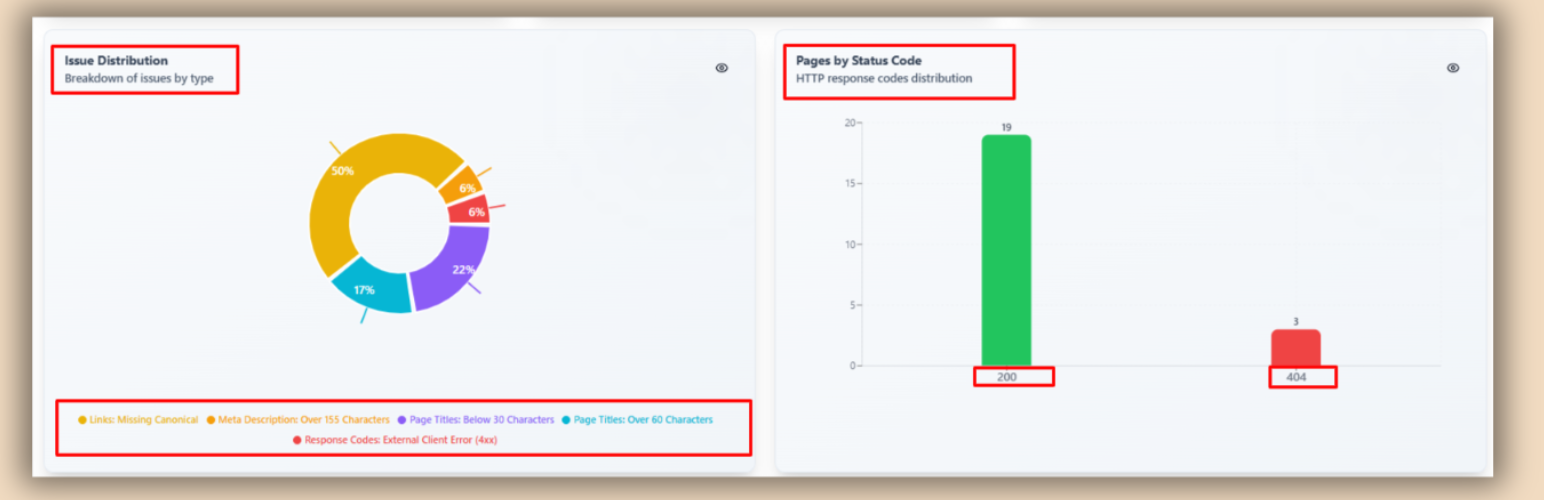
Technical SEO is also an important part of an on page seo audit report because it helps search engines crawl and index your website properly. Even if your content and keywords are optimized, technical SEO issues can prevent your pages from appearing in search results.
Technical SEO includes XML sitemap, robots.txt file, canonical tags, broken links, 404 errors, redirects, HTTPS security, duplicate pages, and indexing issues. During the audit, you should identify these technical errors and provide recommendations to fix them. If technical SEO issues are not fixed, search engines may not crawl or index your website properly, which will negatively affect rankings and organic traffic. Regular technical SEO audits help maintain website health and improve overall SEO performance.
Crawlhunt offers all the points listed in this On Page SEO Audit Report and helps you analyze and optimize your website easily from one dashboard. It allows you to audit URL structure, title tags, meta descriptions, keywords, content quality, internal linking, images, page speed, mobile SEO, and technical SEO issues in one place.
Conclusion
An on page seo audit report is one of the most important documents for improving website SEO performance. Without an audit, you cannot understand why your website is not ranking on search engines. This report helps you identify SEO issues, improve content quality, optimize keywords, fix technical errors, and improve website performance.
For beginners, creating an SEO audit report may look difficult, but if you follow a step-by-step process URL audit, title tags, meta descriptions, content optimization, internal linking, page speed, mobile SEO, and technical SEO, you can easily create a complete audit report.
Regular SEO audits help maintain website health, improve search engine rankings, increase organic traffic, and grow your website. If you want your website to rank on Google, you should create an on page seo audit report regularly and fix all SEO issues.
A well-optimized website always performs better than a website without SEO optimization. So start your SEO audit today and improve your website rankings step by step.