Shopify Sidekick is designed to help merchants manage different parts of their store using AI, from answering questions and generating content to supporting everyday business decisions. But when it comes to SEO, many store owners may wonder whether Sidekick is enough to handle tasks like technical audits, metadata optimization, broken links, image ALT text, and indexing issues.
While Sidekick can support some SEO-related activities, it is not built solely as an SEO tool. This is where dedicated platforms such as CrawlHunt come into the picture. In this blog, we’ll compare Shopify Sidekick SEO capabilities with CrawlHunt to understand where each tool fits and which approach works better for complete store optimization.
What Is Shopify Sidekick?
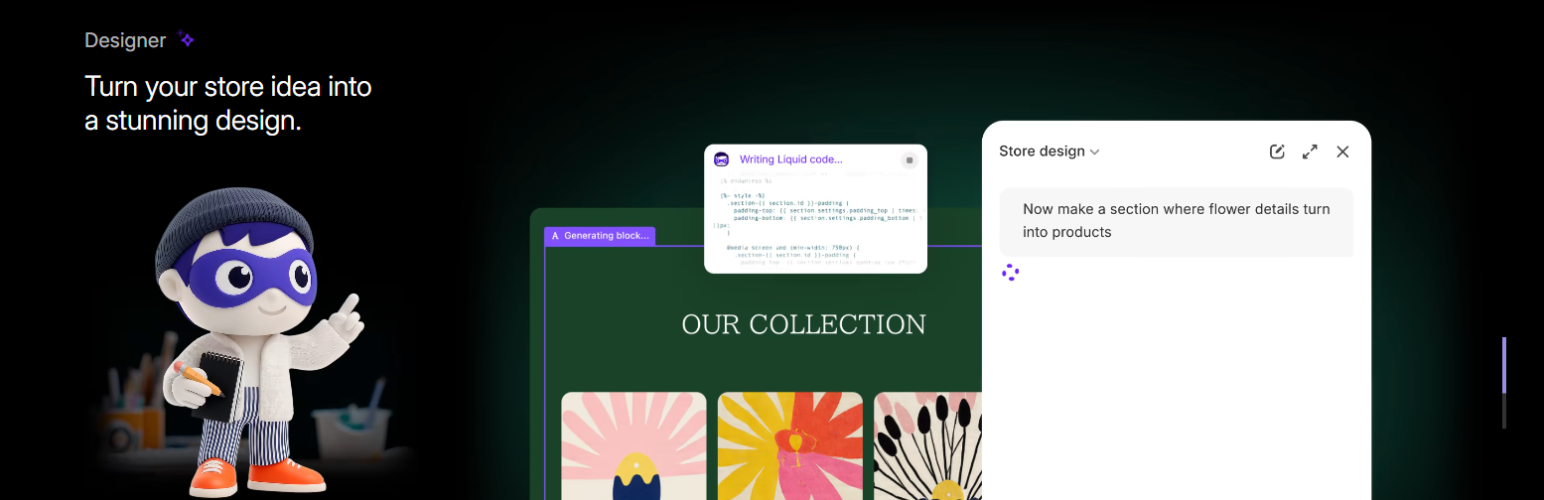
Shopify Sidekick is an AI-powered commerce assistant built directly into the Shopify admin. It allows merchants to ask questions, generate content, analyze store information, create reports, manage products, build workflows, and perform different store-related tasks using everyday language.
Instead of manually navigating through multiple sections of Shopify, merchants can simply describe what they want to accomplish. For example, Sidekick can help create product descriptions, draft blog content, analyze sales data, create customer segments, manage discounts, or provide guidance about different Shopify features.
One of the biggest advantages of Sidekick is that it understands the context of your Shopify store. If you are viewing a particular product, report, collection, or analytics page, Sidekick can use that information when responding to your questions.
How Can Shopify Sidekick Help With SEO?
Although Sidekick is not designed specifically as an SEO platform, some of its capabilities can support everyday SEO activities.
For example, merchants can use Sidekick to:
- Generate SEO-friendly product descriptions.
- Create blog posts around relevant topics.
- Rewrite existing website content.
- Improve product and collection copy.
- Generate content for different Shopify fields.
- Create reports related to traffic and sales.
- Analyze sessions coming from channels such as Google.
- Brainstorm keywords, topics, and content ideas.
Shopify specifically allows Sidekick to generate and edit text across the Shopify admin, including product content, blog posts, marketing materials, and other store information.
This makes Shopify Sidekick SEO useful primarily from a content and productivity perspective.
For example, if you sell running shoes, you could ask Sidekick to create a more descriptive product description containing relevant terms such as “men’s lightweight running shoes.”
Similarly, you could ask it to create a blog article about:
How to Choose Running Shoes for Beginners
These types of activities can indirectly improve your SEO because search engines rely heavily on useful, relevant, and properly structured website content.
However, SEO goes much further than writing content.
What Are the Limitations of Shopify Sidekick for SEO?
Shopify Sidekick can support several SEO-related activities, but merchants should understand that it is primarily a general commerce AI assistant rather than a dedicated SEO auditing platform.
This distinction becomes important when a Shopify store grows and contains hundreds or thousands of products, collections, images, blog posts, redirects, and URLs.
1. Sidekick Depends Heavily on What You Ask
Sidekick primarily works through prompts.
This means merchants generally need to know what they want Sidekick to help them with.
For example, you might ask:
“Improve this product description for SEO.”
Sidekick can help with that task.
But what happens if your store has a technical SEO problem that you don’t know exists?
You might have:
- Broken internal links.
- Missing image ALT attributes.
- Poor page titles.
- Duplicate metadata.
- Incorrect redirects.
- Slow-loading pages.
- Indexing problems.
- Internal linking gaps.
If you aren’t aware of these issues, you might never ask Sidekick about them. A prompt-based assistant also cannot tell you how to fix crawl errors that were never surfaced to you in the first place.
This creates an important difference between an AI assistant and an SEO crawler.
An SEO crawler actively analyzes website URLs looking for problems, while a conversational AI tool typically responds to the questions and tasks you provide.
2. It Is Not Primarily a Full-Site SEO Crawler
Shopify’s official documentation describes Sidekick as an AI commerce assistant that helps merchants generate content, analyze data, manage products, build apps, create reports, and perform administrative tasks.
Shopify does not position Sidekick itself as a dedicated technical SEO crawler designed to systematically crawl every URL of a store and produce a complete SEO issue report.
That matters because large Shopify stores can contain hundreds or thousands of URLs.
A store could have:
- 500 product pages.
- 50 collection pages.
- 100 blog posts.
- Thousands of product images.
- Hundreds of internal links.
Reviewing every page manually would quickly become impractical.
Dedicated SEO tools are designed around discovering these issues automatically rather than waiting for the merchant to investigate pages individually.
3. Technical SEO Goes Beyond Content Generation
Generating better descriptions does not automatically mean your website is technically optimized.
Shopify itself separates SEO into several areas, including on-page SEO, off-page SEO, and technical SEO. Technical SEO includes elements such as site performance, mobile responsiveness, XML sitemaps, robots.txt files, HTTPS, and structured data.
Other technical and structural issues can include:
- URL structure.
- Internal linking.
- Redirect management.
- Crawlability.
- Indexability.
- Duplicate content.
- Canonicalization.
- Broken links.
- Performance problems.
A product description generator does not automatically identify all of these problems. Catching them usually requires a proper technical SEO audit that inspects the site at the URL level rather than the paragraph level.
4. Store-Wide SEO Optimization Can Become Difficult
Using AI to optimize one product is relatively straightforward.
Optimizing 2,000 products is different.
For example, imagine a Shopify store containing:
2,000 products × 4 images = 8,000 images
If hundreds of those images have missing or poor ALT text, fixing them manually becomes a significant task. At that scale, most merchants end up relying on an AI image alt text generator rather than writing each attribute by hand.
Similarly, merchants may need to optimize hundreds of:
- Page titles.
- Meta descriptions.
- Product descriptions.
- Collection pages.
- Internal links.
Shopify recommends optimizing page titles, meta descriptions, ALT tags, headings, and page content as part of good SEO practice.
For smaller stores, manual optimization may be manageable.
For larger stores, merchants generally need a more systematic workflow for finding, grouping, prioritizing, and fixing SEO problems.
5. AI Outputs Still Need Human Review
Another limitation is common to almost every AI platform.
AI-generated content can sometimes contain inaccurate, irrelevant, repetitive, or poorly contextualized information.
Shopify itself recommends reviewing AI-generated content before publishing or applying it.
This is particularly important with SEO.
Automatically inserting keywords everywhere can create unnatural content rather than improve rankings.
Good SEO content still needs to consider:
- Search intent.
- Product relevance.
- Natural keyword usage.
- Customer readability.
- Brand voice.
- Accuracy.
- Conversion potential.
AI should therefore be treated as an assistant rather than an automatic replacement for SEO strategy.
How CrawlHunt Performs Better for SEO Than Shopify Sidekick
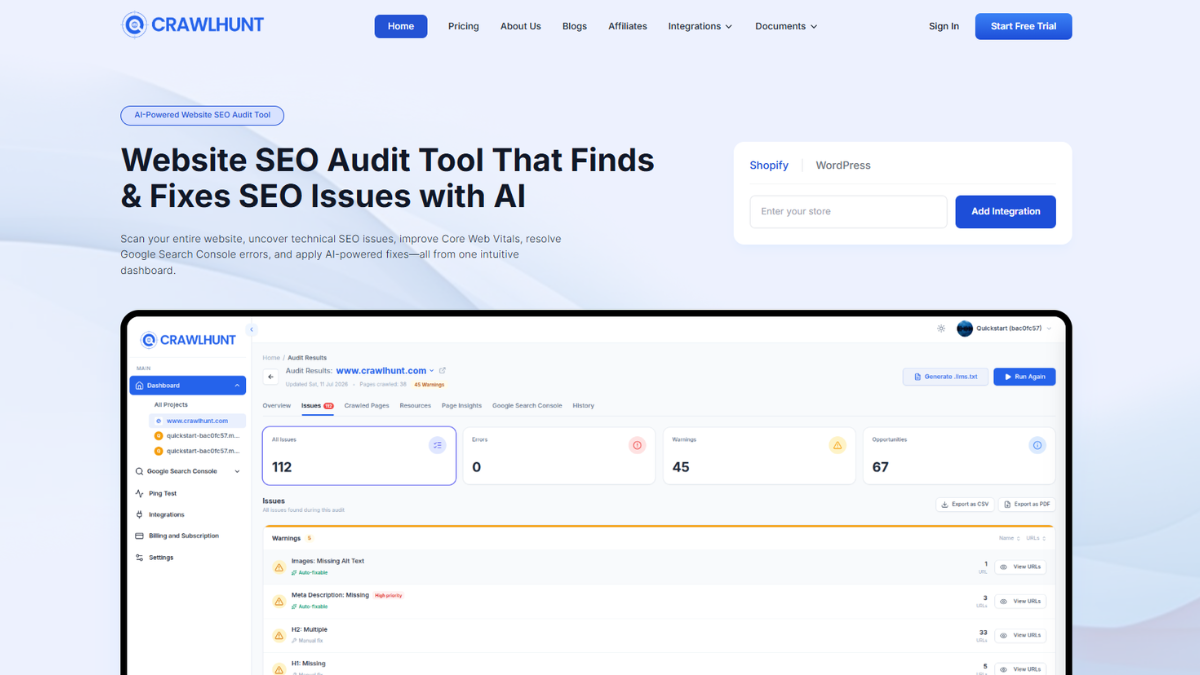
Once a Shopify store moves beyond basic content optimization, SEO becomes much more operational. You are no longer just improving one product description or writing one blog post. You need to understand what is happening across the entire website, which pages need attention, and which fixes will have the biggest impact.
This is where CrawlHunt takes a more SEO-focused approach than Shopify Sidekick.
1. CrawlHunt Turns SEO Into a Structured Workflow
One of the biggest advantages of CrawlHunt is that it gives merchants a clear SEO process to follow.
Instead of handling SEO as a series of individual prompts, the workflow becomes:
Scan the Store → Identify Issues → Review Recommendations → Apply Fixes → Recheck the Website
This makes SEO easier to manage, especially when multiple problems are present at the same time.
A merchant does not need to decide what to investigate first. CrawlHunt organizes the issues and gives a clearer view of the store’s overall SEO condition.
2. It Shows SEO Problems at URL Level
SEO problems are usually page-specific.
One product may have a missing meta description, another may have duplicate metadata, while a collection page may contain an incorrect canonical URL.
CrawlHunt helps merchants see exactly which URLs are affected, which is essentially what a useful on page SEO audit report should deliver.
This is useful because SEO decisions become more actionable when you know:
- Which page has the problem.
- What type of issue exists.
- How many URLs are affected.
- Which pages require immediate attention.
- Which issues can be handled together.
This level of visibility becomes especially important for stores with large catalogs.
3. CrawlHunt Makes Bulk SEO Work More Practical
SEO becomes difficult when the same issue appears across hundreds of pages.
For example, a Shopify merchant may discover:
- 300 products with weak meta titles.
- 500 images without proper ALT text.
- 100 URLs with redirect problems.
- Multiple products using duplicate descriptions.
Fixing these issues one at a time would require significant manual effort.
CrawlHunt is built around bulk SEO management, making it easier to review and apply changes across multiple URLs instead of handling each page separately.
This is a major advantage for growing Shopify stores where SEO tasks quickly become repetitive.
4. AI Is Used Inside the SEO Process, Not as the Entire Process
The difference is not simply that CrawlHunt also uses AI.
The more important difference is where AI is used.
With CrawlHunt, AI supports specific SEO tasks such as generating or improving metadata and other optimization recommendations after SEO problems have already been identified.
This creates a more focused workflow.
Instead of asking AI to generally “improve SEO,” the system can work around a specific issue.
For example:
- Issue detected: Missing meta description
- Next step: Generate an optimized description
- Action: Review and apply
This makes AI more useful because it is connected to a defined SEO problem.
5. CrawlHunt Helps Prioritize SEO Work
Not every SEO issue deserves the same level of attention.
A missing ALT attribute on one image may not be as urgent as a large number of broken pages or serious indexing issues.
An SEO-focused platform can help merchants understand which problems should be addressed first.
This allows teams to spend less time deciding what to work on and more time actually improving the store.
For larger businesses, this can also make SEO easier to assign across developers, marketers, content teams, and store managers.
6. SEO Changes Can Be Checked Again After Fixing Them
Making an SEO change is only half the process.
You also need to confirm whether the problem has actually been resolved.
This is where repeated crawling becomes valuable.
After implementing changes, merchants can scan the website again and check whether previously identified problems are still present.
This creates a continuous improvement cycle:
Detect → Fix → Recheck → Improve
That is much more reliable than assuming a change worked simply because it was saved inside Shopify. It also helps when you are rolling out a broader internal linking strategy, where the effect of each change needs to be verified across many connected pages.
7. CrawlHunt Gives Merchants a Dedicated SEO View
Another practical advantage is focus.
Shopify admin contains products, orders, customers, analytics, marketing, discounts, apps, settings, and many other areas.
CrawlHunt provides a dedicated environment focused specifically on website SEO.
This means merchants can evaluate their store from an SEO perspective without mixing SEO tasks with everyday store administration.
For marketing teams, this can make it easier to monitor progress and maintain an ongoing optimization routine.
8. It Is Better Suited to Larger Shopify Stores
Sidekick may be sufficient for occasional SEO assistance on smaller stores.
But the requirements change when a store grows to hundreds or thousands of URLs.
At that point, merchants need more than individual recommendations.
They need:
- Store-wide visibility.
- Issue categorization.
- Bulk optimization.
- Repeated crawling.
- Progress tracking.
- Technical SEO monitoring.
- Scalable workflows.
CrawlHunt is better suited to this type of SEO operation because it is designed around the website as a whole rather than individual conversations or isolated tasks.
9. CrawlHunt Complements Sidekick Rather Than Replacing It
It is also important to understand that this does not necessarily need to be an either-or decision.
Shopify Sidekick remains useful for general Shopify activities such as content creation, reports, business insights, store management, and everyday AI assistance.
CrawlHunt simply goes deeper when the objective becomes SEO.
A merchant could therefore use:
- Sidekick for general Shopify assistance
- CrawlHunt for SEO auditing, optimization, and ongoing monitoring
This combination makes more sense than expecting one general AI assistant to handle every aspect of technical and on-page SEO.
The Key Difference
The simplest way to understand the difference is:
Shopify Sidekick helps you perform SEO-related tasks. CrawlHunt helps you manage SEO as an ongoing process.
That difference becomes increasingly important as your Shopify store grows and SEO moves from occasional optimization to continuous website management.
Conclusion
Shopify Sidekick can be useful for merchants who want quick AI assistance with content, store management, reporting, and everyday Shopify tasks. It can also support some SEO-related activities, particularly around content creation and optimization. However, complete Shopify SEO requires more than generating descriptions or answering individual prompts.
Store owners also need to identify technical issues, monitor URLs, optimize pages at scale, and regularly review their website health. This is where a dedicated SEO platform such as CrawlHunt becomes more practical. Rather than replacing Sidekick, CrawlHunt can complement it by providing a more structured approach to SEO auditing, optimization, and continuous monitoring for growing Shopify stores.
FAQs
1. Is Shopify Sidekick good for SEO?
Shopify Sidekick can help with SEO-related tasks such as content creation, product descriptions, and general optimization guidance, but it is not a complete technical SEO platform.
2. Can Shopify Sidekick perform a full SEO audit?
Sidekick is primarily a general Shopify AI assistant. For store-wide SEO crawling, issue detection, and technical analysis, a dedicated SEO tool is more suitable.
3. What is the main difference between Shopify Sidekick and CrawlHunt?
Sidekick focuses on general Shopify assistance, while CrawlHunt focuses specifically on SEO auditing, issue detection, optimization, and ongoing website monitoring.
4. Do I need CrawlHunt if I already use Shopify Sidekick?
It depends on your SEO requirements. Sidekick may be enough for basic assistance, but larger stores or merchants focused heavily on organic growth may benefit from a dedicated SEO platform.
5. Can Shopify Sidekick and CrawlHunt be used together?
Yes. Sidekick can support general Shopify tasks and content creation, while CrawlHunt can handle deeper SEO auditing, optimization, and monitoring.